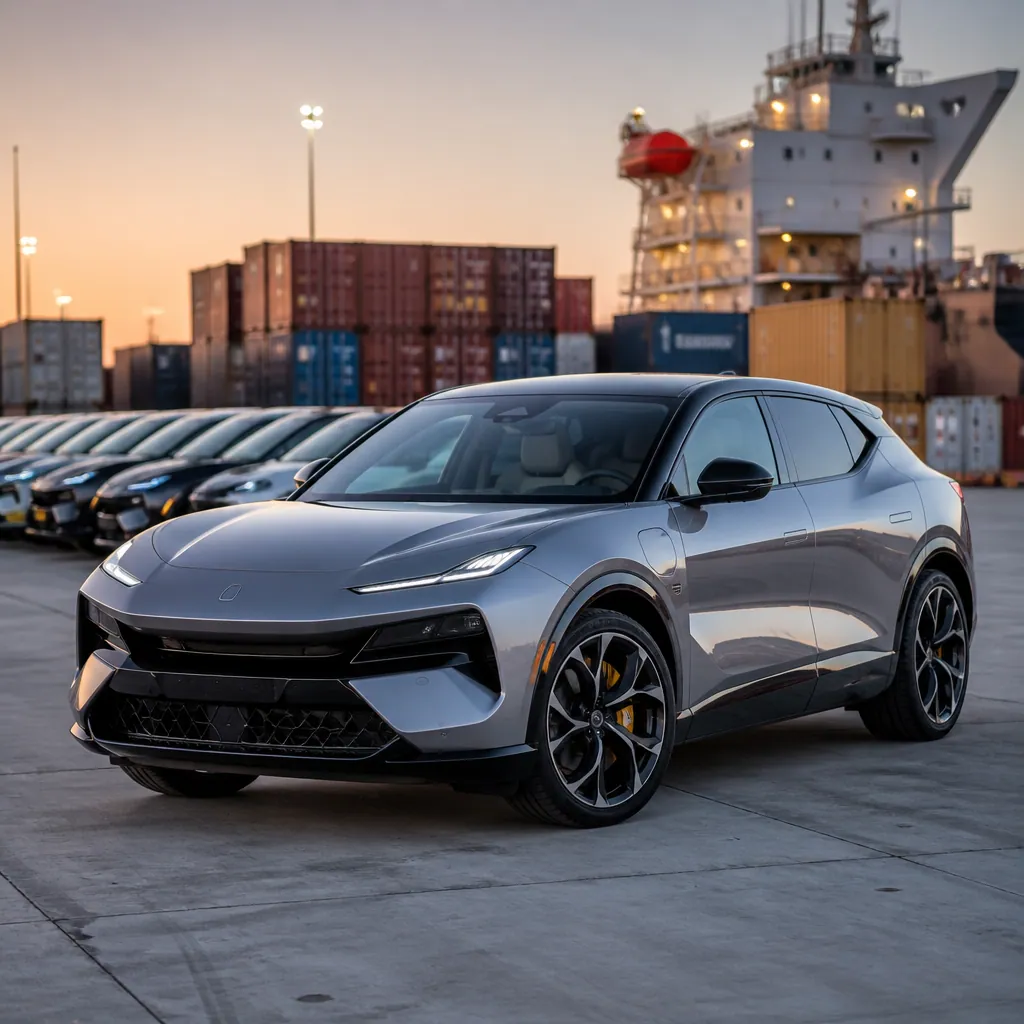
Buying a brand new vehicle from China and shipping it internationally sounds straightforward until the container arrives and the spec does not match what was quoted, or a fault code surfaces at destination customs. This is the single biggest anxiety every vehicle dealer, importer, and fleet operator carries when sourcing from overseas. A rigorous vehicle inspection China export process is the only real answer, and at Automotion Global, we treat it as non negotiable. This article walks you through every stage of our five stage pre export inspection, explains what we check and why, and shows you what separates a transparent process from a paperwork only formality.
Quick Takeaways
| Key Insight | Explanation |
|---|---|
| VIN verification is the foundation of every inspection | If the VIN on the vehicle does not match the invoice and export documents, customs can hold the shipment indefinitely. We verify this before anything else. |
| Specification compliance must be confirmed against the purchase order | Color, trim level, engine type, transmission, and optional extras are cross checked against the confirmed order, not the factory standard catalog. |
| A full diagnostic scan is required before export approval | Any active, pending, or historical fault codes in the ECU are flagged and resolved before the vehicle is cleared for loading. |
| Export documentation errors cause more delays than mechanical faults | Mismatches between declared value, VIN, and vehicle description account for most customs holds. Document review is a dedicated inspection stage, not an afterthought. |
| Photographic records protect both buyer and supplier | Every inspection stage is documented with time stamped photos. If a dispute arises at destination, the pre shipment record settles it without guesswork. |
| Fluid levels and battery condition are checked for long duration shipping | Vehicles in transit for four to six weeks need correct fluid levels and fully charged batteries to arrive in drive ready condition. |
| Destination market compliance is reviewed at inspection, not at port | Emissions standards, steering configuration, and safety equipment requirements vary by market. Confirming compliance before loading avoids expensive returns or modifications abroad. |
Why Pre Export Inspection Matters More Than You Think
Most disputes in international vehicle trade do not start with a mechanical failure. They start with a mismatch: the wrong color, the wrong trim, a VIN that does not appear on the customs declaration, or a fault code that was already present when the vehicle left the factory yard. By the time the unit reaches a port in the Middle East, Africa, or Southeast Asia, resolving any of those issues costs far more in time, money, and customer trust than it would have cost to catch them in China.
A pre export car inspection done properly is not a box ticking exercise. It is the moment in the supply chain where a qualified inspector verifies the actual vehicle against the confirmed order, the export documents, and the destination market requirements, all at once. At Automotion Global, this inspection is part of our standard process for every unit we ship, whether that is a single passenger car for a private buyer or a fleet of commercial vehicles for a distributor.
A pre shipment inspection is only as useful as the detail behind it. A one page pass certificate with no photographic record, no VIN cross reference, and no diagnostic data is not an inspection. It is a signature on a blank sheet of paper.
The stakes are real. A vehicle held at destination customs for a documentation mismatch can accumulate storage fees quickly, miss a selling window, and damage the commercial relationship between a dealer and their end customer. Our five stage process is designed specifically to prevent those outcomes.
Stage 1: Identity Verification and VIN Check
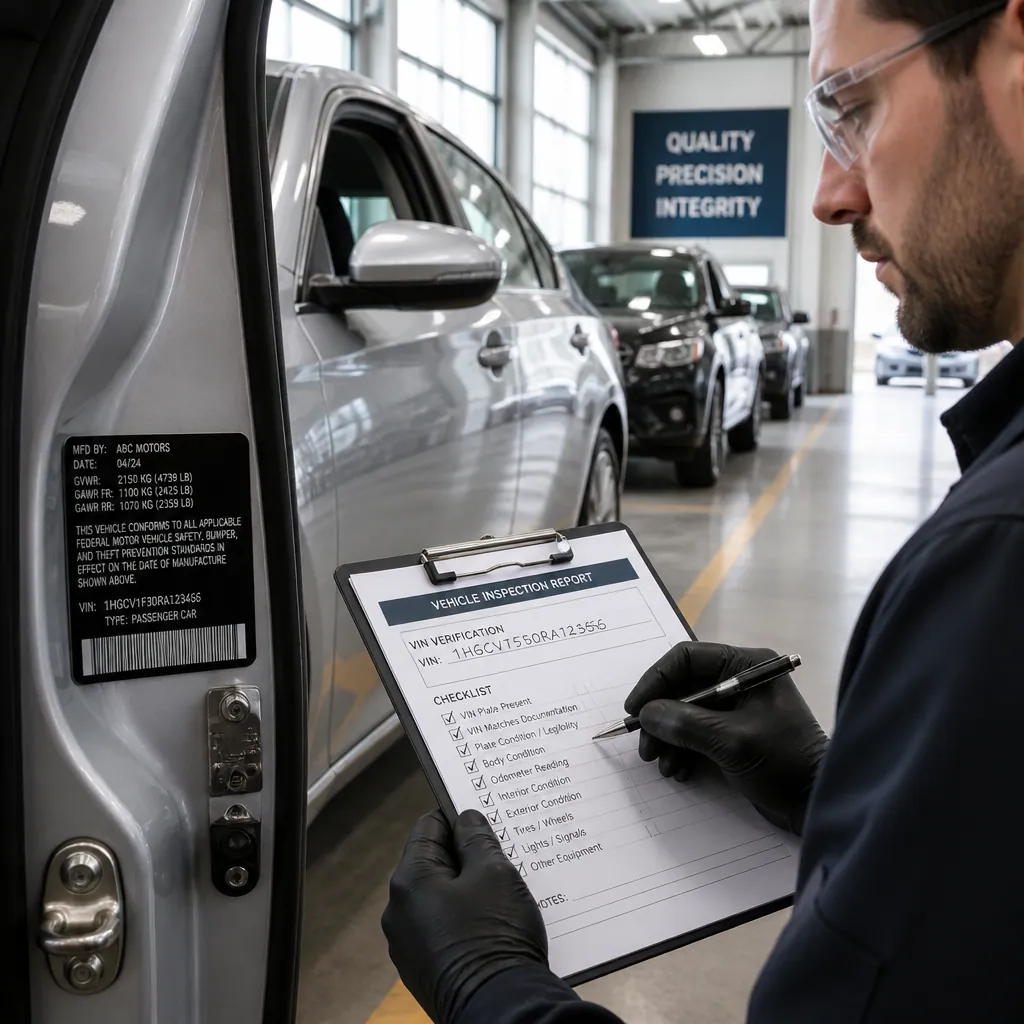
The first stage of our quality check China vehicles process is identity verification. Before any physical inspection of the bodywork or mechanical systems begins, we confirm that the vehicle in front of us is the correct vehicle: the right make, model, variant, and year, with a VIN that exactly matches the purchase order, the pro forma invoice, and the export documentation package.
What the VIN Check Covers
The VIN is cross referenced against the manufacturer’s certificate of origin, the customs export declaration, and the commercial invoice. Any discrepancy, even a single transposed character, is flagged immediately and escalated to the supplier before the inspection continues. This is not a precaution we apply selectively. A VIN mismatch is the most common cause of customs holds in vehicle export, and catching it at source costs nothing compared to resolving it at the destination port.
We also verify that the vehicle is genuinely new and unregistered, with zero kilometers on the odometer or consistent with factory transit mileage only. For dealers and distributors buying at volume, this matters because some units move through multiple hands before reaching the exporter’s yard, and every additional handover introduces risk.
Pro tip: When you receive a pro forma invoice from any vehicle exporter, request that the VIN is printed on that invoice before you confirm payment. If the supplier cannot provide a VIN at quotation stage, ask why. A legitimate new vehicle sourced directly from a manufacturer or bonded warehouse will always have a traceable VIN.
Stage 2: Exterior and Structural Inspection
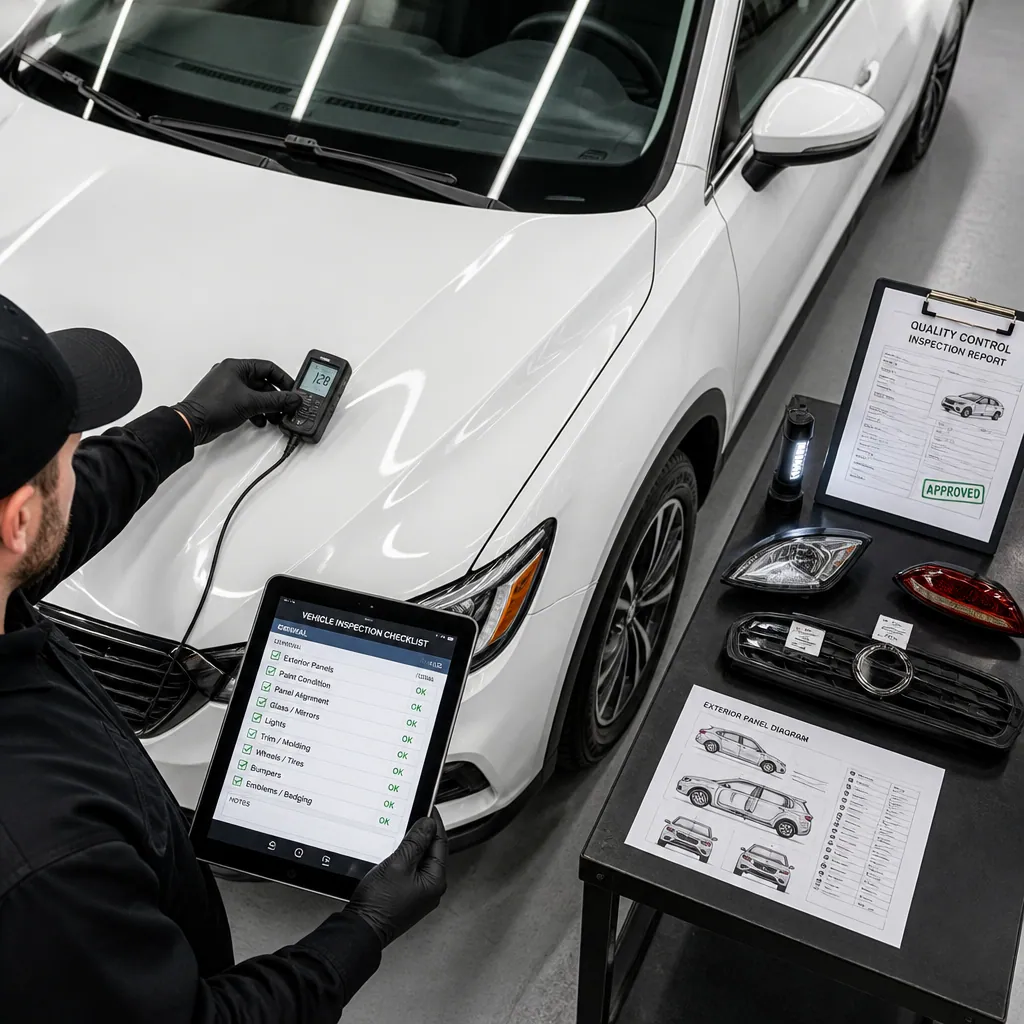
Stage two moves to the vehicle’s exterior. This covers paint condition, body panel alignment, glass, lights, trim, and any evidence of structural damage, transit damage, or previous repair work. For new vehicles shipped from China, the most common exterior issues found at this stage are minor transit scratches, paint transfer marks from factory wrapping materials, and panel gaps that fall outside acceptable tolerance.
Paint, Body, and Glass
Every body panel is inspected visually and, where relevant, with a paint depth gauge to detect any filler or respray that would indicate prior damage. Glass is checked for chips, cracks, and correct sealing. Lights, lenses, and reflectors are tested for function and verified against the destination market’s road legal requirements, because lamp configurations differ between right hand and left hand traffic markets.
Structural Integrity
Panel gaps and door alignment are checked against manufacturer tolerances. Any evidence of structural deformation, however minor, is documented with photographs and reported to the buyer before loading is approved. We do not make the call to proceed on a vehicle with structural concerns without explicit buyer confirmation. That decision belongs to the buyer, with full information in hand.
Every finding at this stage is documented with time stamped photographs. The photographic record becomes part of the inspection report that travels with the shipment documentation, giving the buyer a clear pre shipment baseline if any condition question arises at destination.
Pro tip: Ask your vehicle supplier for the exterior inspection photographs before the unit is loaded. A supplier who cannot or will not provide these photographs before shipment is telling you something important about the transparency of their process.
Stage 3: Interior and Electrical Systems Check
The interior inspection covers everything a buyer or end customer will interact with from the moment they open the door. Seat condition, dashboard integrity, infotainment function, air conditioning, all interior lighting, power windows and mirrors, horn, and seatbelt operation are checked systematically. For electric vehicles and plug in hybrids, the charging port, onboard charger function, and battery management display are included in this stage.
Specification Compliance Against Confirmed Order
This is the stage where specification compliance is verified. The confirmed order, which details trim level, seat material, infotainment version, connectivity features, language settings, and any optional extras, is used as the reference document. It is not sufficient to verify that a vehicle is the correct model. The correct trim and configuration must be confirmed as well. A dealer who ordered a top spec unit with a sunroof and heated seats cannot sell a base spec unit as equivalent.
Language and regional settings on infotainment systems are also checked and configured for the destination market where this is required. This is a detail many exporters skip, and it consistently generates complaints at dealer handover when the navigation system defaults to Mandarin or the speed warnings are calibrated to kilometers per hour in a market that uses miles.
Electrical System Function
All electrical systems are tested: lighting circuits, including headlights on high and low beam, fog lights, indicators, hazard lights, and reverse lights. Climate control, heated seats where fitted, power accessories, and USB and charging ports are all verified. Any non functional item is documented and a resolution is agreed with the supplier before export approval is issued.
Stage 4: Mechanical and Diagnostic Assessment
Stage four is where the vehicle’s mechanical and drivetrain systems are assessed. For new vehicles, this stage is less about uncovering serious defects and more about confirming that no factory fault has been overlooked and that the vehicle is in drive ready condition for the duration of the shipping journey and for use at destination.
Full OBD Diagnostic Scan
A full on board diagnostics scan is run to check for active, pending, or stored fault codes across all vehicle control modules: engine, transmission, ABS, airbag, and any advanced driver assistance systems. The ECU log must be clear before export approval is granted. A vehicle with an active fault code that clears and returns is not export ready, and we treat it as such.
Fluid Levels, Tyres, and Battery
Engine oil, transmission fluid, coolant, brake fluid, and windscreen washer fluid are all checked and topped up to correct levels. Tyre pressures are set to the manufacturer’s recommended specification. The 12-volt battery is tested under load to confirm it will hold charge during a shipping journey that may last several weeks without the vehicle being started.
For electric vehicles and plug in hybrids, high voltage battery state of charge is confirmed and set to a shipping safe level, typically between 30 and 50 percent, consistent with manufacturer guidance for long duration transit. This protects battery chemistry and meets most international shipping carrier requirements for lithium ion battery transport.
Brakes, Steering, and Suspension
Brake pad condition, brake disc surfaces, and handbrake function are checked. Steering operates correctly with no play or noise. Suspension is visually inspected for any damage that may have occurred during factory to yard transit. These checks confirm the vehicle is mechanically sound and safe to drive immediately on arrival, without the buyer needing to schedule a workshop visit before putting the unit to use.
Stage 5: Documentation Review and Export Clearance
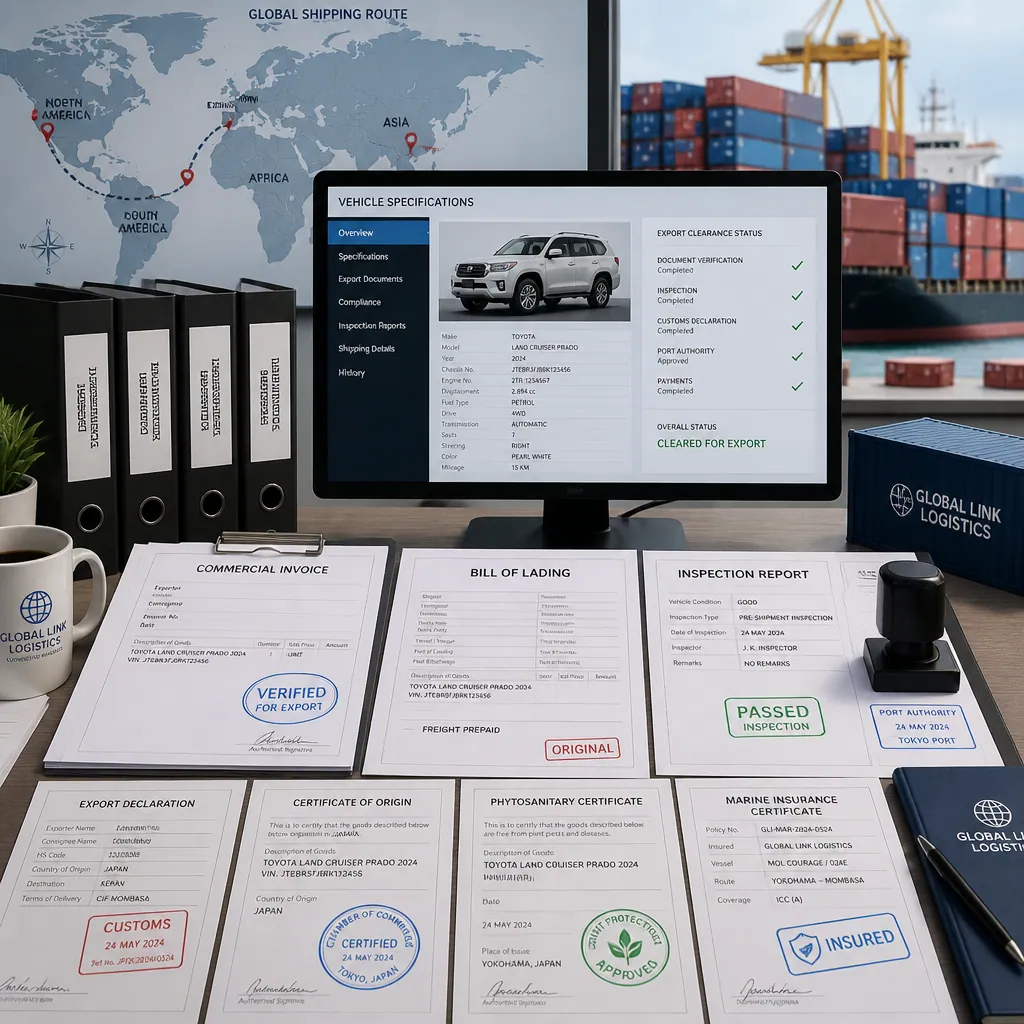
The fifth stage is the one most often treated as routine by less thorough exporters, and the one that causes the most problems when it is not done carefully. Export documentation review means cross checking every document in the shipment file against the physical vehicle and against the destination country’s import requirements.
Core Document Set
The standard export file for a vehicle from China includes the commercial invoice, the manufacturer’s certificate of origin, the VIN certificate, the vehicle specification sheet, the packing list, and the bill of lading. Depending on the destination country, it may also include an emissions compliance certificate, a safety or homologation certificate, or a specific import permit. Every document is reviewed for accuracy: the VIN on every document must match, the declared value must be consistent, and the vehicle description must be unambiguous.
Any discrepancy between documents, however small, is corrected before the export declaration is submitted. A mismatch between the declared value on the invoice and the customs declaration is a common reason why shipments are flagged for physical inspection at destination, which adds days or weeks to the delivery timeline and can trigger additional duties or penalties.
Destination Market Compliance Confirmation
At this final stage, we confirm that the vehicle as configured meets the import and registration requirements of the destination market. This includes verifying that the vehicle’s emissions rating meets the applicable local standard, that the lighting configuration is correct for the traffic direction, and that any mandatory safety equipment, such as specific warning triangle requirements or reflective markings for some African and Middle Eastern markets, is present and compliant.
Only when all five stages are complete, and all findings are either resolved or formally accepted by the buyer, does Automotion Global issue export clearance and authorize the vehicle for loading onto the container or Ro Ro vessel.
Inspection Method Comparison
Not all pre export inspection approaches deliver the same level of assurance. Below is a comparison of the three most common models used in the China vehicle export market, including how Automotion Global’s process compares.
| Inspection Approach | What It Typically Covers | Key Limitation |
|---|---|---|
| Factory self inspection (supplier issued certificate only) | Basic visual check by factory QC staff, pass certificate issued by the same party supplying the vehicle | No independent verification. The supplier is checking their own product with no external accountability. Disputes at destination have no independent pre shipment record to reference. |
| Third party inspection report (single visit, no documentation cross check) | Physical vehicle condition assessed by an independent inspector, usually covering exterior and interior. Report issued with photographs. | Without a full documentation cross check and OBD diagnostic scan, compliance and identity risks remain. A vehicle can pass a visual inspection and still have an active fault code or a VIN mismatch on its export documents. |
| Automotion Global 5-Stage Process (integrated inspection and documentation review) | Identity verification, exterior structural inspection, interior and electrical check, full OBD diagnostic scan, and complete export documentation review. All stages documented with photographs. | Requires more time than a single visit inspection. For buyers who are under deadline pressure, this is the trade off. In practice, the time invested at inspection stage saves far more time than it costs by preventing delays at the destination port. |
Frequently Asked Questions
Does Automotion Global use third party inspectors or conduct inspections in house?
Automotion Global uses a combination of in house oversight and established inspection partners in China, depending on the vehicle type, supplier location, and destination market requirements. What does not change is the scope: every vehicle goes through all five stages, and every report is reviewed by our team before export clearance is issued. We do not outsource the decision making, even when a partner inspector conducts the physical checks.
Can I request a copy of the inspection report before my vehicle is loaded?
Yes. Automotion Global provides buyers with the inspection report, including the photographic record, before loading is authorized. This is standard for all orders, not a premium add on. You should review the report and raise any questions before the vessel departs. Once the unit is on water, options for resolution narrow considerably.
What happens if the vehicle fails any stage of the inspection?
A failed stage does not automatically mean the vehicle is rejected. It means the finding is documented, reported to the buyer, and a resolution is agreed before the inspection continues. For minor findings, such as a cosmetic scratch or a low fluid level, the issue is rectified and re inspected before clearance. For significant findings, such as a VIN mismatch or an unresolved fault code, the vehicle does not receive export clearance until the issue is resolved with the supplier. The buyer is kept informed throughout.
How long does the full 5-stage inspection take?
For a standard passenger car or SUV, the full five stage inspection typically takes between four and eight hours depending on vehicle complexity and the completeness of the documentation file at the time of inspection. Electric vehicles and plug in hybrids take longer due to the additional battery and charging system checks. Fleet orders are scheduled across multiple inspection days with progress reporting provided to the buyer throughout the process.
Does the inspection cover destination market emissions and safety compliance?
Yes. Destination market compliance is reviewed at stage five, the documentation and export clearance stage. This includes confirming that the vehicle’s emissions certification meets the applicable standard for the destination country, that the lighting configuration is correct for the road traffic rules of that market, and that any specific safety or equipment mandates for that market are met. If a compliance gap is identified, it is resolved before the vehicle is cleared for export.
Is the inspection process the same for commercial vehicles and fleet orders as it is for passenger cars?
The five stage framework is consistent across all vehicle types. The specific checklist items within each stage are adapted for the vehicle type. A commercial van or truck will include additional checks on payload capacity ratings, commercial lighting configurations, and load bearing components. Fleet orders include batch level documentation review to ensure consistency across all units in the consignment, since a discrepancy in one unit’s documentation can hold an entire multi vehicle shipment at customs.
Have you shipped vehicles from China before? Share your experience with pre export inspection in the comments, we read every response and use your feedback to sharpen our process.
References
- Overview of pre shipment inspection standards and their role in international trade quality control
- China quality control and inspection: types, services, and key checklist items for pre shipment verification
- Automobile logistics and customs clearance for vehicle exports: stages, timelines, and common delay causes
- China vehicle export quality standards: inspection procedures and compliance requirements for international shipments