
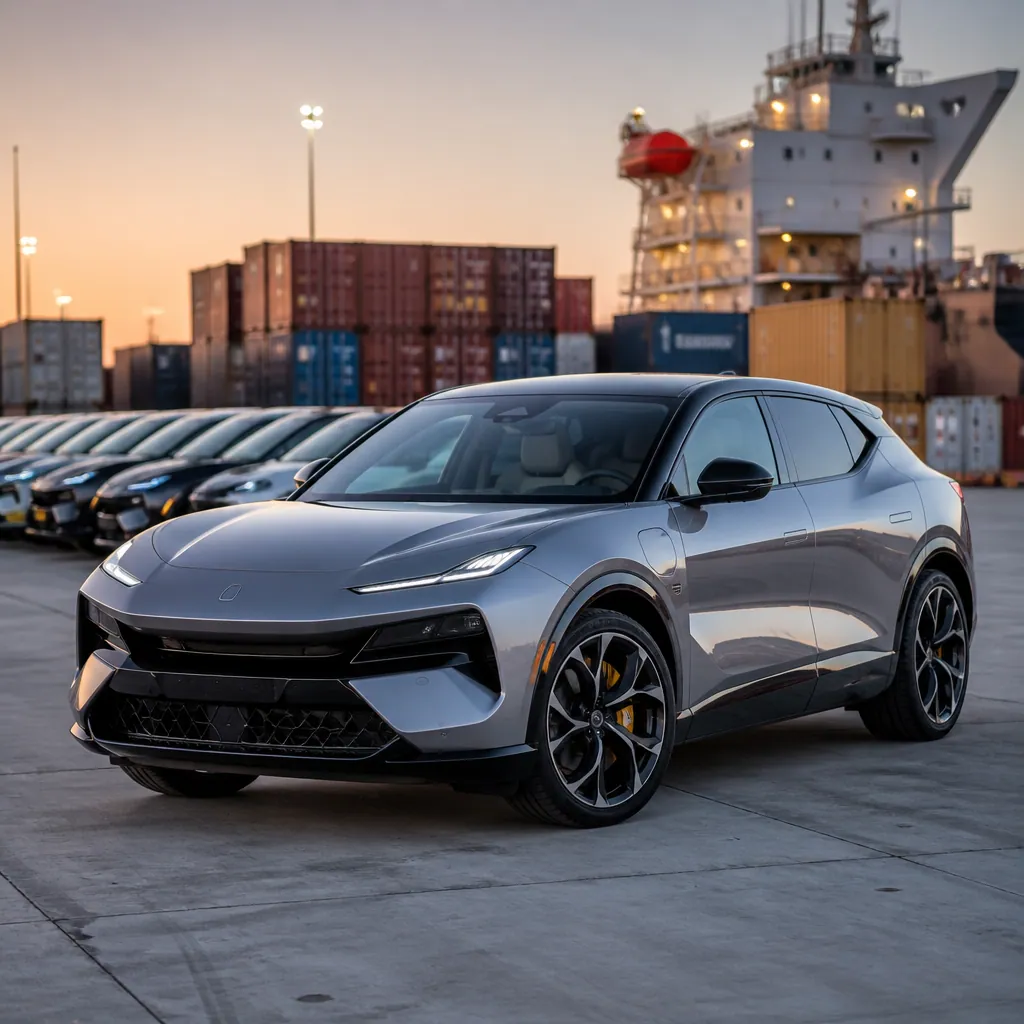
Lotus built its name on light, simple sports cars. Its latest move goes the other way. The Lotus For Me is a plug in hybrid version of the Eletre SUV, pairing a 2.0-litre turbocharged four cylinder engine with two electric motors and a 70 kWh battery for a combined 939 hp. For dealers, distributors and fleet operators weighing a Lotus For Me PHEV export deal, the performance is not the open question. The open questions are whether your buyers can charge the car, whether your market will accept the name and specification, and whether the landed cost still works. This guide covers each one before you commit stock.
Quick Takeaways
| Key Insight | Explanation |
|---|---|
| Sell it as a large EV with a generator | Top Gear describes the hybrid as very much electric biased, with the petrol engine mainly driving a generator. Lead with the battery and charging speed. |
| Do not sell it on lightness | Road & Track says the car comes in around 5,800 lb, roughly the same as the all electric Eletre. A weight focused pitch will fail with any customer who knows the brand. |
| Screen buyers for charging access | Top Gear says Lotus is aiming the hybrid at buyers who fear finding a charger. If your customers have home or depot charging, the case is strong. If they do not, the hybrid is the safer sale. |
| Expect questions about name and specification | Road & Track expects the Lotus For Me name to stay mainly in China, the debut market. Confirm the name, badging and specification for your country before taking a deposit. |
| Model landed cost before quoting | Road & Track notes that China built Lotus models are expensive in the United States because of tariffs. Build the full cost stack from factory gate to registration. |
| Plan fuel logistics around a 50-litre tank | Top Gear lists a 50-litre fuel tank. That gives short petrol range for a large SUV, so the car suits buyers who recharge regularly. |
What the Lotus For Me Actually Is
The Lotus For Me is the combustion engined version of the Eletre, unveiled as the plug in hybrid counterpart to the all electric SUV. Road & Track describes it as more complicated than the EV and about as heavy. That matters because the Eletre has not met the sales Lotus hoped for, and this variant is aimed at a different buyer.
From the outside, the change is subtle. Top Gear reports more cooling grille at the nose and exhaust pipes at the rear, while the interior is largely unchanged apart from hybrid information on the screens. Buyers will compare it directly with the electric car, so your sales team needs a clear answer to why they would choose the hybrid.
Where It Sits in the Eletre Range
Road & Track notes the battery has only 38 kWh less capacity than the all electric Eletre, so this is not a small battery plug in with a large petrol tank. Top Gear calls the system very much electric biased. In practice, you are selling a large EV with a range extender, and the sales conversation should start with the battery and charging, not the engine.
Naming needs checking early. Top Gear’s UK review calls the hybrid the Eletre X, while Road & Track uses the Lotus For Me name. Buyers will search for both, so your listings, invoices and registration paperwork must match the name and model code your supplier confirms for your market.
Performance Numbers Worth Checking
Top Gear reports a combined output of 939 bhp and a 3.3-second sprint to 62 mph, a figure it compares with a top end Porsche Cayenne Turbo GT. Road & Track reports the same 939 hp maximum and says it beats the most powerful existing all electric Eletre. Two independent reviews agree on the headline number, but you still need homologated figures for your market before printing numbers in a brochure.
How the Engine and Motors Share the Work
The 2.0-litre turbocharged four cylinder sits transversely in the nose and largely drives a 150 kW generator, according to Top Gear. It can also clutch into a single speed transmission to drive the front wheels, which the review identifies as the most efficient way to use petrol at cruising speed. The two electric motors, front and rear, do most of the pushing.
For a salesperson, the message is simple. Under hard acceleration the car feels like an electric performance SUV, and the engine acts as a reserve that keeps the battery from running flat on longer journeys. Do not describe it to customers as a sporty petrol car with a battery added.
Charging on a 900-Volt System
Top Gear says the system runs at 900 volts and, on the latest chargers, can take the battery from 20 to 80 percent in about nine minutes. That is a reviewer’s measurement on a specific charger type, not a guarantee. Real charging speed depends on the station, the cable, the temperature and the state of charge when you plug in.
The same review estimates real world electric range at around 150 miles. Treat that as a reviewer’s estimate. Customers will ask for range in their local test cycle, so get official figures from the manufacturer before the first showroom visit.
Pro tip: Ask your supplier for the charging curve and the list of supported charging standards in writing. A 900-volt architecture only helps a buyer if the fast chargers near them match it.
Weight, Platform and the Lotus Ethos
Lotus has always sold a philosophy of simplicity and lightness. Road & Track quotes the founding idea, simplify, then add lightness, and points out that the Lotus For Me moves the other way. At roughly 5,800 lb, it is about as heavy as its electric sibling, so the brand’s old argument about weight does not carry over.
That gap between brand story and product is where dealers get into trouble. Some owners will still expect Lotus handling from a car that weighs what an EV weighs. Lead with comfort, straight line performance and the cabin, not agility.
Why the Weight Did Not Drop
The arithmetic is straightforward. The car carries a 70 kWh battery, two electric motors, a 2.0-litre engine, a 150 kW generator, a transmission and a 50-litre fuel tank. Removing the petrol system would save some mass, but the battery alone is large. The hybrid trades simplicity for range flexibility, and the weight stays close to the EV.
The Geely Platform Underneath
Top Gear reports that Lotus engineers call the car a new Geely platform. Beneath the body, it has different front end and floor structures from the all electric Eletre R, along with new suspension parts. The Zeekr 9X uses versions of the same platform and drivetrain, which is useful context if a buyer asks where the hardware comes from.
A shared platform can help with parts planning and technical support, but only if your supplier provides a clear parts list. Ask for the service documentation, the diagnostic software language and parts availability by region before you sign.
A plug in hybrid sells on the buyer’s charging situation, not on the badge on the tailgate.
Export Economics, Tariffs and Market Access
Road & Track says Lotus electric SUVs are extremely expensive in the United States because of tariffs on vehicles made in China, and that Lotus has not seen the sales it hoped for from its flagship. Top Gear adds that demand at the luxury end has been weaker than expected, and that Lotus is adding the hybrid to attract buyers wary of charging. Both points carry the same lesson for exporters: China built luxury cars carry a price problem, and volume does not follow from the spec sheet.
The quote you send a distributor must reflect the whole route to registration, not just the ex factory price. Origin port, destination duties and the buyer’s financing structure all change the final number. If one of those steps is missing, the margin you promised will disappear once the first invoice is paid.
Building a Landed Cost Model
Each landed cost model should cover factory price, inland transport to port, ocean freight, marine insurance, import duties and taxes, conformity or homologation work, inspection, port handling and local registration. Charges vary by country, so build a separate model for each market. Give a distributor a range only where you can document every line.
Confirming Name and Specification by Market
Road & Track expects the Lotus For Me name to stay mainly in China, so a buyer elsewhere may get a different name, a different trim or no official offer at all. Get written confirmation of the model name, specification, emissions standard, steering position and software language. Do this before you take a deposit, not after the container is booked.
Buyer Profiles That Fit a Luxury PHEV
The Lotus For Me suits buyers who want a premium SUV with strong acceleration and a clear electric driving experience, but who cannot guarantee charging at every stop. That is a narrower group than the broad luxury market. Target it on purpose instead of pitching the car to everyone who walks through the door.
Fleet Operators With Mixed Routes
Executive fleets and chauffeur businesses often run a mix of city work and longer intercity trips. A plug in hybrid lets them drive electric in town and use petrol where the route has no reliable fast charger. The 50-litre tank limits petrol range, so fleet managers should map fuel stops as carefully as charging stops.
Fleet buyers also ask about running cost per kilometre and service intervals. Those answers must come from the manufacturer and your supplier before a tender is submitted, not from guesses on the sales floor.
Private Buyers in Markets With Patchy Charging
Private buyers without home charging look like an obvious target, and they are also the most likely to be disappointed. A hybrid with a 70 kWh battery still needs regular plug in time to deliver its electric experience. Ask every private buyer where they will charge before they sign, and be honest if the answer is a public network with limited availability.
Comparing Lotus For Me Against Other Premium Options
The Lotus For Me is not the only premium choice for buyers who want power and a hybrid option. In most showrooms, its closest comparisons will be the all electric Eletre and conventional luxury plug in SUVs. Edmunds lists several of these in its 2026 and 2027 luxury hybrid rankings, including the Mercedes Benz GLE 450e, Lexus RX 450h+ and BMW X5 xDrive50e. The table below compares them from an exporter’s point of view, using Lotus figures from the sources cited in this article.

| Option | Strengths | Trade offs for Exporters |
|---|---|---|
| Lotus For Me PHEV | 939 hp combined output, 70 kWh battery, 900-volt charging system, petrol range extender | Around 5,800 lb, 50-litre fuel tank, debut market is China, name and specification may change for export |
| All electric Lotus Eletre | Battery about 38 kWh larger than the hybrid, similar weight, Lotus says it can add about 400 km of range in 20 minutes | No petrol backup, depends fully on charging access, sales have fallen short of Lotus’s own hopes |
| Conventional luxury plug in SUVs such as the Mercedes Benz GLE 450e, Lexus RX 450h+ and BMW X5 xDrive50e | Buyers already know these brands, which can shorten the sales conversation | Output and specification differ by model, so verify each one directly with the manufacturer before comparing |
The comparison points to a clear split. The Lotus For Me wins on output and on the story of a hybrid that drives like an EV. It loses on weight, on fuel range and on export certainty. Conventional rivals win on familiarity, which matters most to buyers who are new to Lotus.
Pre Shipment Checklist for Dealers and Fleets
Before you place a Lotus For Me order, run the same checks you would apply to any new vehicle programme. Confirm the model name, specification and build year with the supplier. Then confirm how the car will be inspected, documented and shipped. A clean order on paper can still stall at the port if one document is wrong.
Inspection and Export Documentation
Ask for a pre shipment inspection report with photographs of the body, the underside, the battery state of charge and the software version. Documentation should carry the same vehicle identification number across the invoice, certificate of conformity, packing list and bill of lading. In practice, a mismatch on a single line is one of the fastest ways to delay clearance.
Spare Parts and Aftersales Coverage
A hybrid has two drivetrains to support, so the parts list is longer than for a standard EV. Ask which high voltage components, engine parts and cooling parts are stocked in your region, and how long they take to arrive. Agree on warranty responsibility for the battery and generator before the first car is delivered.
Pro tip: Order a starter set of service and wear parts with the first shipment. Waiting for a parts request after delivery is where dealer reputations are lost.
Pro tip: Ask your supplier for a detailed photo set of the drivetrain and cabin before you commit the full order, so your sales team can answer technical questions with confidence.
Frequently Asked Questions
Is the Lotus For Me the same car as the all electric Lotus Eletre?
No, but they share the same body and most of the same interior. Road & Track describes the Lotus For Me as the internal combustion version of the Eletre, and says its battery has only 38 kWh less capacity than the all electric model.
How much power does the Lotus For Me produce?
Road & Track reports a maximum output of 939 hp, and Top Gear reports a combined output of 939 bhp with a 3.3-second sprint to 62 mph. Check the homologated figures for your market before using these numbers in marketing.
How far can the Lotus For Me travel on electric power alone?
Top Gear estimates around 150 miles of real world electric range from the 70 kWh battery. That is a reviewer’s estimate, not an official figure, so confirm range under your local test cycle before quoting it to customers.
Will the Lotus For Me be sold under the same name in every export market?
Not necessarily. Road & Track expects the name to stay mainly in China, where the car debuts, so export markets may see a different name or specification. Get written confirmation from your supplier before promising a model name or trim to a buyer.
What should a dealer check before ordering a Lotus For Me PHEV export shipment?
Start with landed cost, the charging access of your target buyers, the specification for your market and the aftersales parts plan. Then confirm the inspection report, documentation and the warranty split for the battery and generator. Skipping any one of these creates a delay you will have to explain to the customer.
Is a plug in hybrid a better choice than an all electric SUV for luxury buyers?
Charging access decides it. If your customers can charge at home or at work, the all electric version usually makes more sense. If they cannot, the hybrid removes the range worry that Top Gear says Lotus is trying to address with this model.
If you have quoted or imported a Lotus For Me or a similar luxury plug in, tell us which question your buyers asked first, whether it was charging, price or delivery timing, so we can cover it in a future guide.