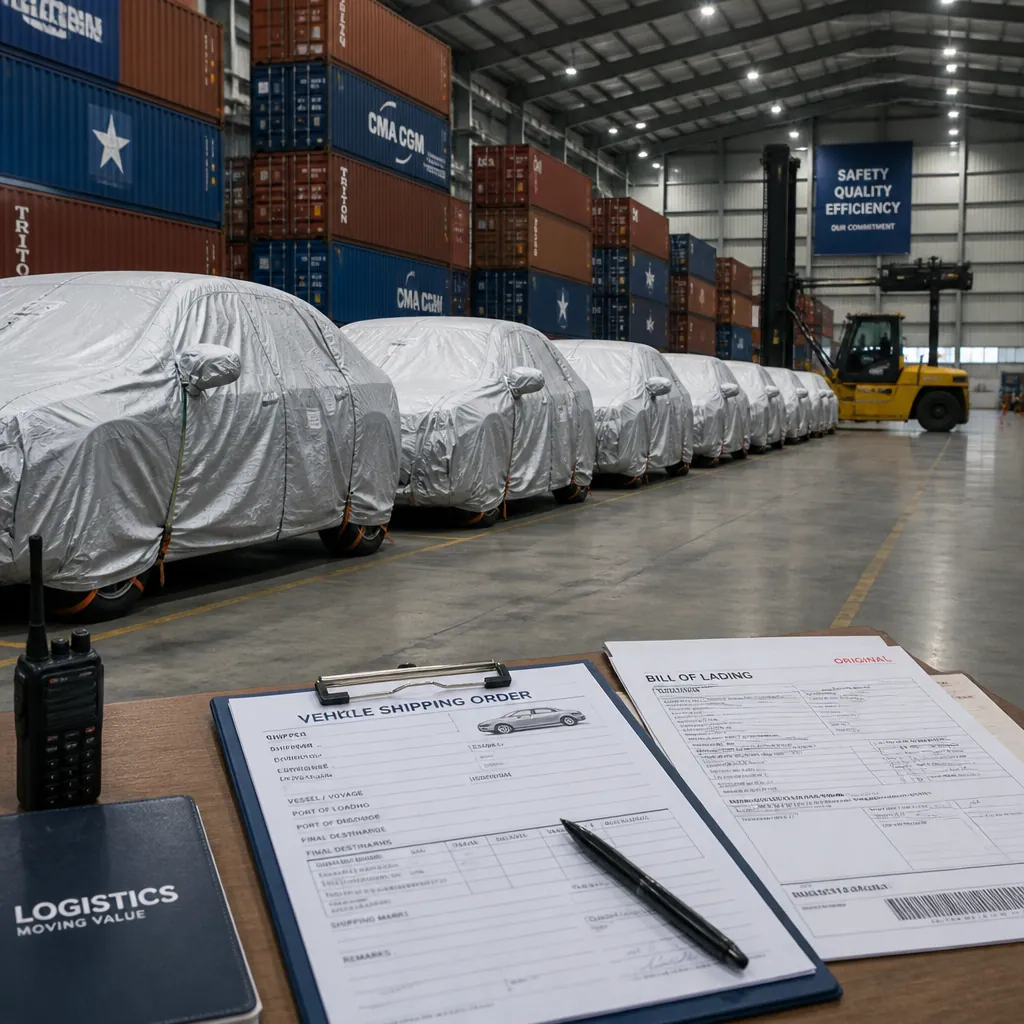
Most vehicle dealers and security buyers who start looking into armored vehicles export China expect a straightforward procurement process. They quickly discover it is anything but. Chinese manufacturers produce a wide range of civilian and government grade armored vehicles, from ballistic rated SUVs to cash in transit vans, at price points that are often 30 to 50% below equivalent Western built units. But the export pathway, compliance landscape, and quality verification layer are genuinely complex. Buyers who skip due diligence on protection ratings, export licensing, or end user documentation routinely end up with vehicles that cannot clear customs in their destination country, or that fall short of the rated protection they paid for.
Why the Chinese Armored Vehicle Market Matters Right Now
The demand for armored vehicles across the Middle East, Africa, and parts of Asia is not theoretical. Fleet operators, government agencies, private security firms, and commercial clients in these regions actively source protection rated vehicles because the threat environments they operate in justify the cost. The question is no longer whether to buy armored, but where to source from.
China has become a serious alternative to traditional North American and European armoring manufacturers. Chinese manufacturers like Norinco, Dongfeng, and BAIC produce both military derived and purpose built civilian armored platforms. Export volumes to Africa, Southeast Asia, and the Middle East have grown steadily, driven primarily by cost competitiveness and improving build quality. For dealers and distributors operating in those markets, ignoring the Chinese supply chain is leaving a real commercial opportunity on the table.
That said, “Chinese armored vehicle” covers an enormous range of quality and compliance. A dealer sourcing a B6-rated armored SUV from a certified Chinese armoring specialist is dealing with a very different product, and a very different export process, than one ordering a field conversion vehicle from a general purpose truck manufacturer’s side operation. This distinction matters more in this product category than almost any other.
Types of Armored Vehicles Available from China
Chinese suppliers offer armored vehicles across several distinct categories. Understanding which category fits a buyer’s end use is the first step toward identifying the right source, the right protection rating, and the right export pathway.
Civilian VIP and Executive Protection Vehicles
These are typically based on production SUV or sedan platforms, such as the Toyota Land Cruiser, Mercedes GLS, or Chinese branded equivalents like the BYD Tang or BAIC BJ80. A Chinese armoring specialist purchases the base vehicle, strips the body panels and glazing, installs certified ballistic steel and polycarbonate laminated glass, and rebuilds the vehicle to look essentially stock from the outside. This category is the most commercially relevant for dealers serving government clients, corporate security, and high net worth individuals.
Protection levels for this category typically run from B4 to B6covering threats from high powered handguns up to 7.62x51mm rifle rounds. Some manufacturers offer B7 configurations, though weight and performance trade offs become significant at that level.
Cash in Transit and Security Transport Vehicles
Van based armored units used by banks, cash logistics companies, and security firms represent a separate and high volume segment. Chinese manufacturers produce bespoke CIT vehicles with reinforced body structures, secure compartments, run flat tires, and entry control systems. This is a strong growth segment for Chinese exporters serving African and Southeast Asian financial institutions.
Light Tactical and Patrol Vehicles
Vehicles in this category, such as the Dongfeng Mengshi series derived from PLA (People’s Liberation Army) platforms, are primarily purchased by government and law enforcement clients. Export of these vehicles involves a separate and more demanding set of Chinese government approvals and is not typically accessible through commercial channels. Dealers operating in the civilian and fleet space should be aware of this distinction and not conflate the two supply chains.
Protection Levels Explained: B4, B6, B7 and What They Actually Mean
Protection ratings are the single most important specification in any armored vehicle transaction, and they are also the most frequently misrepresented. Every dealer sourcing a Chinese armored vehicle needs to understand the core standards before placing an order.
The dominant framework for civilian armored vehicles in international commercial trade is the European standard EN 1063 (also referred to as CEN), which classifies ballistic resistance on a B1 through B7 scale. A parallel system, VPAM (from the German testing association), is also common, particularly for European and Middle Eastern government procurement. The NIJ standard used in the United States covers body armor and is less commonly applied to vehicle exports, though some buyers specify it for comparison.
What B4, B6, and B7 Actually Stop
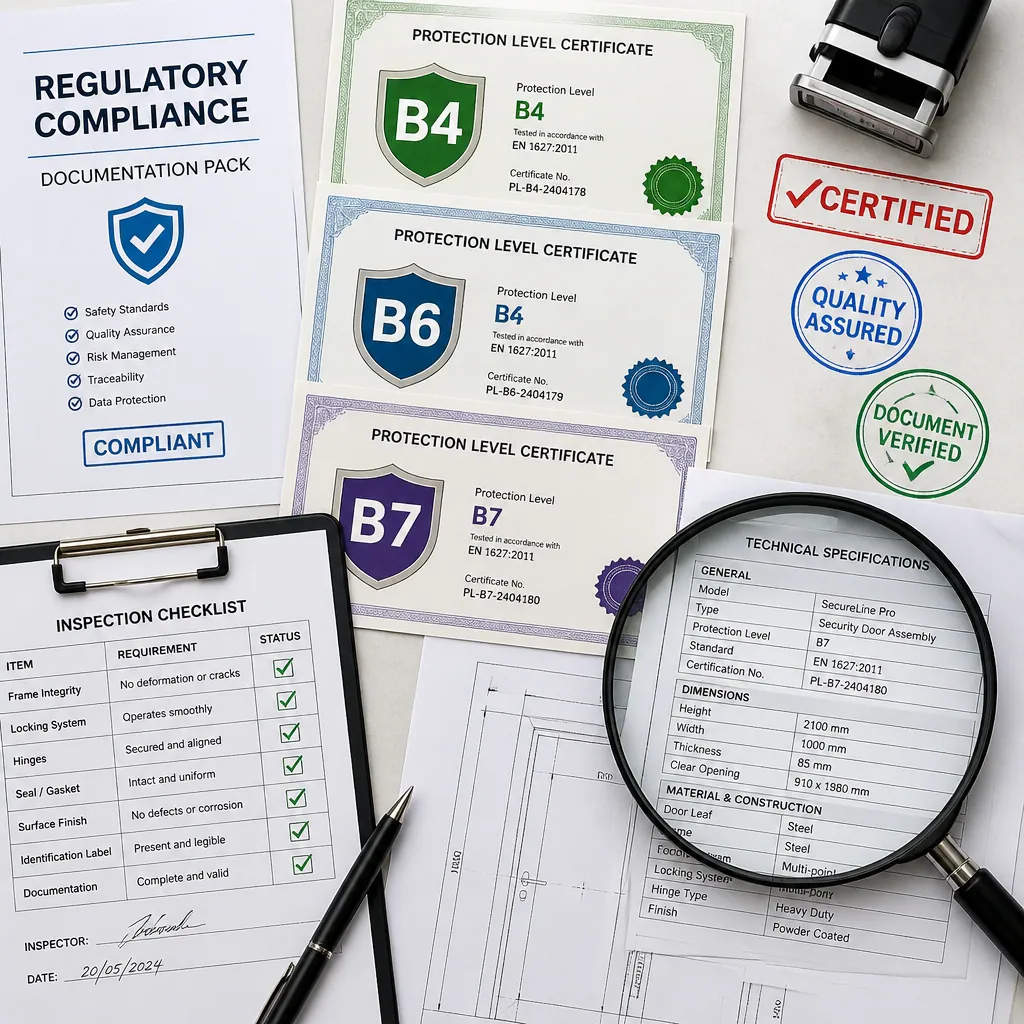
B4 protection is designed to stop handgun threats up to .44 Magnum. This is the minimum meaningful protection level for cash in transit vehicles and is adequate for environments where the primary threat is armed robbery at close range with handguns. B6 protection, which is the most widely specified level for VIP and executive protection vehicles, is rated to stop 7.62x51mm NATO rifle rounds. B7 stops armor piercing rounds from high velocity rifles and is typically reserved for high risk diplomatic, government, or special purpose applications. More armor means more weight, and weight affects braking, suspension, and in some cases top speed, so choosing a level higher than the threat assessment warrants is a genuine operational mistake, not just an unnecessary cost.
When sourcing from China, buyers must insist on certification from an accredited third party ballistics testing laboratory, not just the manufacturer’s internal testing data. Certificates should reference the specific standard (EN 1063, VPAM), the protection level achieved, and the test batch or vehicle identifier. A certificate tied to a generic material sample rather than a completed vehicle configuration is not equivalent.
Pro tip: Always ask for the certificate number and verify it with the issuing laboratory directly before finalizing any order. Suppliers who resist this step are a red flag, regardless of how competitive their pricing is.
Export Compliance from the Chinese Side
China’s export control framework has undergone significant development. The Export Control Law, which came into force in 2020, and the subsequent Regulations on the Export Control of Dual Use Items, which became effective on December 1, 2024, have created a more structured and in some ways more demanding compliance environment for exporters of items that could serve both civilian and military purposes.
Armored vehicles occupy a genuinely ambiguous position in this framework. A civilian VIP protection vehicle built on a commercial SUV platform is not a military product, but the ballistic materials used in its construction, and in some configurations the vehicle itself, can attract dual use scrutiny. Chinese exporters are required to apply for licenses from the Ministry of Commerce (MOFCOM) when dealing with items on the Dual Use Control List or subject to temporary control measures. The consolidated Control List, aligned with the 2024 regulations, covers goods and technologies that can contribute to enhancing military potential.
In practice, reputable Chinese armoring companies have these export pathways established and can demonstrate the relevant approvals. The risk lies with smaller or less experienced suppliers who may not have navigated this process correctly, leaving the buyer holding a shipment that cannot be released or that triggers compliance issues in the destination market.
The most expensive part of a failed armored vehicle shipment is not the customs fine. It is the six month delay in delivering vehicles to a security client who needed them immediately.
For buyers in the Middle East and Africa, the practical implication is straightforward: your supplier must be able to provide documentation showing that the export was legally authorized on the Chinese side, not just that the vehicle left the port. Automotion Global handles this coordination as part of its full export solution, including supplier qualification, documentation review, and customs procedures, which is precisely the kind of end to end support that matters most in this product category.
Import Requirements on the Destination Side
Importing an armored vehicle is rarely as simple as importing a standard passenger car, and the requirements vary significantly by destination country. Dealers need to understand both the vehicle classification rules and, in some markets, the end user licensing requirements before they commit to a purchase.
Vehicle Classification and Customs HS Codes
Armored vehicles are typically classified under HS code 8710.00 (tanks and other armored fighting vehicles) or, more commonly for civilian models, under the standard passenger vehicle or commercial vehicle codes depending on how the vehicle is presented. The classification affects the duty rate and, more importantly, determines which regulatory authority reviews the import. Misclassifying a B6 armored SUV as a standard passenger vehicle to reduce duties is a compliance risk that can result in seizure and penalties.
End User Documentation and Permits
Several countries in the Middle East and Africa require an import permit or end user certificate specifically for armored vehicles, separate from the standard vehicle import process. Some require that the importer be a licensed security company or government entity. Dealers operating as distributors need to confirm these requirements before sourcing, not after the vehicle arrives at the destination port. Getting this wrong means the vehicle sits in a bonded warehouse accumulating demurrage costs while the paperwork is sorted out.
Pro tip: Build the end user permit application timeline into your delivery schedule when quoting clients. In some markets this process takes 30 to 90 days. Quoting a 60-day delivery on a vehicle that requires a 90-day permit process creates a credibility problem with your client that is entirely avoidable.
Comparison: Three Sourcing Approaches for Dealers and Importers
Dealers sourcing armored vehicles from China broadly have three routes to market. The table below compares them on the dimensions that matter most in practice.
| Sourcing Approach | Key Characteristics | Best Suited For |
|---|---|---|
| Direct from Chinese Armoring Manufacturer | Lowest unit cost; requires buyer to manage export licensing, third party inspection, shipping, and destination customs independently. Language barrier and time zone differences add friction. MOQ may apply. | Large volume buyers with in house export and compliance teams and existing relationships in China. |
| Via a China based Trading Company | Adds a layer between buyer and manufacturer; pricing is higher than direct. Quality control and documentation responsibility varies widely. Limited accountability if specification or compliance problems arise post shipment. | Buyers testing the market with small orders who accept higher unit cost in exchange for lower upfront effort. |
| Via a Specialist International Vehicle Exporter (e.g., Automotion Global) | Full service solution covering sourcing, supplier vetting, inspection, export documentation, shipping, and aftersales support. Transparent pricing. Single point of accountability. No need for the buyer to manage multiple Chinese counterparties. | Dealers, fleet operators, and distributors who want reliable supply chain management without building their own China operation. Particularly strong for first time or mid volume buyers in the Middle East and Africa. |
The direct from manufacturer route is only genuinely cost efficient above certain volume thresholds and when the buyer already has the internal capability to manage export compliance. Below that threshold, the cost savings typically disappear in logistics errors, documentation delays, and inspection failures.
Verification and Inspection Before Shipment
This section is where most problems are either caught and resolved, or missed and exported. Pre shipment inspection for armored vehicles is not the same as a standard vehicle pre delivery inspection. There are several layers.
Physical Completeness and Armor Coverage Inspection
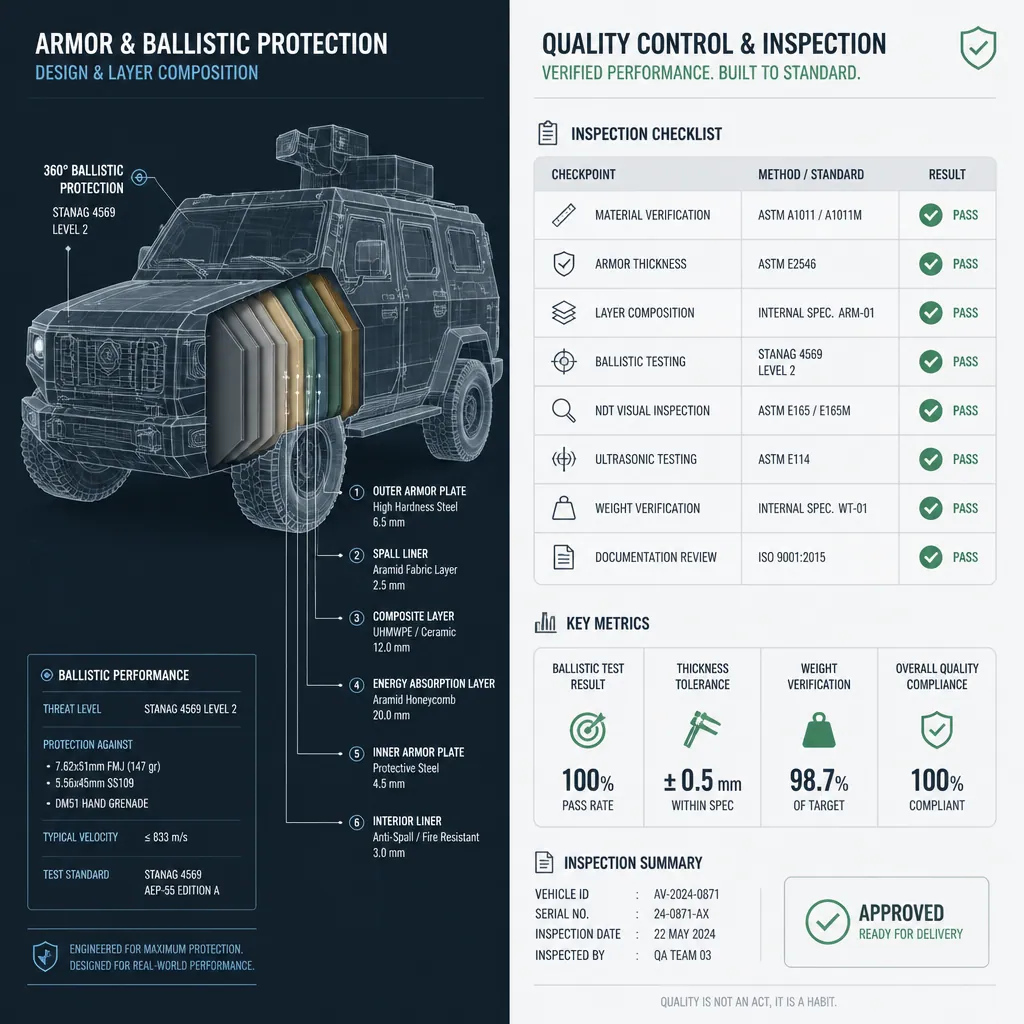
An armoring job can look complete from the outside and still have gaps in coverage around door pillars, floor sections, or the firewall. A qualified pre shipment inspector will check that the armor package matches the specification sheet, that ballistic glass is correctly fitted with no visible gaps or delamination, that the door overlap system is intact, and that run flat inserts (if specified) are installed. This requires an inspector with specific armored vehicle experience, not a general automotive inspector.
Documentation Package Review
Before any vehicle ships, the buyer or their agent should verify the complete documentation package: the ballistic certificate from an accredited laboratory, the Chinese export authorization, the factory inspection report, the vehicle identification documentation, and the commercial invoice with accurate HS code classification. Any gap in this package creates a risk at the destination port.
Weight and Performance Verification
A B6-rated armoring package adds significant weight to a base vehicle, typically several hundred kilograms depending on vehicle size and glass area. Buyers should confirm that the completed vehicle’s weight is within the rated capacity of the base platform’s suspension and braking system. Armor packages that overload the base vehicle’s GVWR are a liability issue and in some markets a roadworthiness compliance failure.
Common Mistakes That Cost Dealers Time and Money
After working through the sourcing and compliance process for armored vehicles from China, certain mistakes appear repeatedly. These are the ones worth addressing explicitly.
The first is ordering based on a supplier’s claimed protection level without requesting a third party certificate. Some suppliers list B6 protection in their marketing materials based on the steel grade they use, not on a completed vehicle test. These are not the same thing.
The second is assuming that a vehicle’s successful export from China guarantees its legal importability in the destination country. Export permission and import permission are separate processes governed by separate authorities. Dealers have received vehicles at destination ports only to discover that local law requires a specific import permit for armored vehicles that was never applied for.
The third is conflating military derived vehicles with commercially available civilian armored vehicles. The Dongfeng Mengshi CSK-131, for example, is a PLA platform that has been acquired by foreign militaries including Tunisia’s armed forces. It is not a commercial product a civilian dealer can freely source through normal export channels. Attempting to order it as if it were a standard commercial vehicle is a compliance failure, not a procurement strategy.
The fourth is neglecting aftersales and spare parts planning. Armored vehicles have specialized components, particularly ballistic glass, run flat systems, and reinforced door hardware, that are not available from standard automotive parts networks. Before committing to a specific model, dealers need to confirm how spare parts will be sourced and what lead times look like for their destination market.
Frequently Asked Questions
Can civilian buyers outside China legally purchase and import an armored vehicle sourced from China?
Yes, in most cases, but the process involves two separate compliance checks: export authorization from the Chinese side and import authorization in the destination country. For civilian VIP protection vehicles built on commercial platforms, this is a manageable process with the right documentation support. Military grade or military derived vehicles follow a separate and much more restricted pathway that is not accessible to civilian commercial buyers.
What protection level should dealers recommend for clients in high risk commercial environments?
B6 is the most widely specified protection level for corporate, VIP, and government civilian applications. It provides meaningful protection against rifle caliber threats while keeping the vehicle’s weight within a range that preserves drivability and allows for effective evasive maneuvers. B4 is appropriate for cash in transit and armed robbery threat environments. B7 is reserved for genuinely extreme threat profiles and comes with significant weight and performance trade offs that need to be discussed with the end user before specification.
How do Chinese armored vehicles compare in quality to North American or European alternatives?
The quality range among Chinese suppliers is wide. The best Chinese armoring specialists use certified ballistic materials, submit vehicles to third party testing laboratories, and produce work that is competitive with mid tier North American and European alternatives. The challenge is that the market also includes lower quality operators whose claims are not backed by verifiable certification. Supplier qualification and third party inspection are therefore more important when sourcing from China than when sourcing from a supplier with an established international reputation.
What is the typical lead time for sourcing and exporting an armored vehicle from China?
Lead times vary depending on whether the vehicle is in stock or built to order. Stock units in standard configurations can ship within 30 to 60 days from order confirmation, accounting for inspection and documentation. Built to order vehicles with specific protection levels, configurations, or base platforms typically require 90 to 150 days from order to vessel loading. Destination side import permitting timelines are additional and can range from a few weeks to several months depending on the country.
What documentation should dealers require before accepting delivery of an armored vehicle from a Chinese supplier?
The minimum documentation package should include: a ballistic protection certificate from an accredited independent laboratory referencing the specific vehicle or batch, the Chinese export authorization documents, the manufacturer’s vehicle specification sheet confirming armor coverage areas and materials, the commercial invoice with correct HS code classification, and the bill of lading. Vehicles without a complete and verifiable documentation package should not be accepted regardless of how strong the price proposition is.
Does Automotion Global handle armored vehicle sourcing from China?
Yes. Automotion Global provides a complete vehicle export solution that covers sourcing, supplier coordination, pre shipment inspection, export documentation, customs procedures, and international shipping for vehicles exported from China, including armored and security rated vehicles for qualified buyers. Their service model is specifically designed for dealers, fleet operators, and distributors in the Middle East, Africa, and Asia who want full service support rather than managing multiple Chinese counterparties independently. You can reach the Automotion Global team directly via the contact page to discuss specific requirements.
If you have sourced or are currently sourcing armored vehicles from China, share your experience in the comments or send us a message. We would like to know what challenges came up in your process and how you resolved them.
We would love your feedback and any insights you would share with others. What perspective would you add?
References
- Pillsbury Law: China’s 2024 Dual Use Export Control Regulations explained
- ArmorMax: Armored vehicle protection ratings B4 to B7 and NIJ standards compared
- Alpine Armoring: NIJ, CEN, and VPAM armor level standards for vehicles
- Military Africa: Tunisia acquires Dongfeng Mengshi Chinese armored vehicles