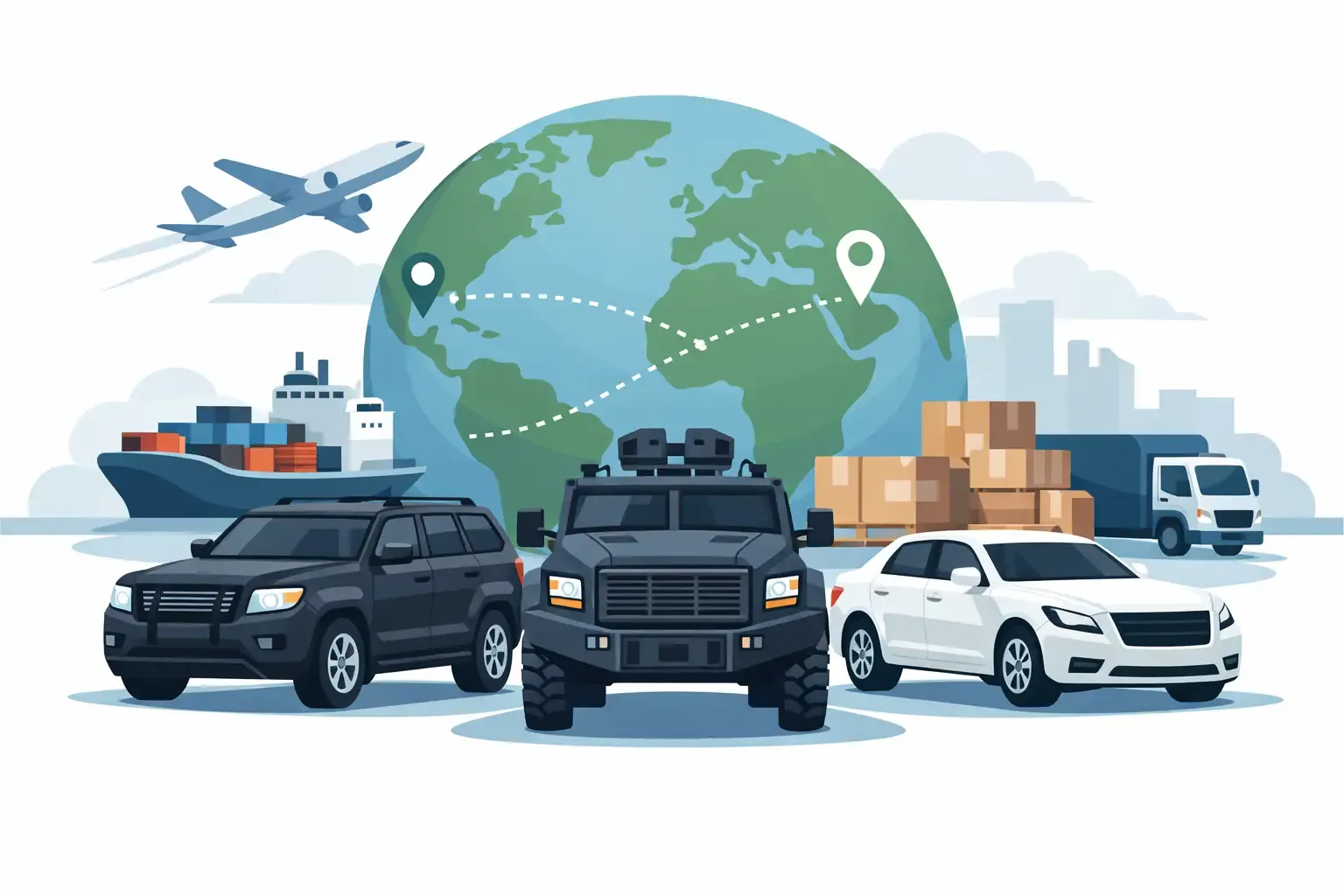


A vehicle listed online is not automatically a vehicle that can be exported, documented correctly, and delivered on schedule. Effective vehicle sourcing begins with confirming the physical unit, its specifications, its export eligibility, and the route it will take to the destination market. For individual buyers, fleets, resellers, and procurement teams, that difference determines whether a transaction stays on budget or becomes an avoidable operational delay.
Global buyers often need more than local market availability. They may require an EV configuration unavailable at home, a commercial unit built for a specific application, an armored vehicle with defined protection requirements, or a volume order that must arrive within a commercial timeline. The right sourcing partner turns these requirements into a verified purchase and a managed export process.
What Vehicle Sourcing Means in International Trade
Vehicle sourcing is the process of locating, verifying, securing, and preparing vehicles for purchase and export. It is not limited to finding a make and model at an attractive price. A complete sourcing process considers supply status, trim level, production year, condition, documentation, export restrictions, inspection requirements, shipping method, and destination market suitability.
For a buyer importing one vehicle, this may mean finding a ready to deliver unit with the correct left hand or right hand drive configuration. For a fleet operator, it may mean securing multiple matching commercial vehicles with consistent specifications, warranty information, and delivery timing. For a reseller, the priority may be access to high demand inventory that can be delivered with clear export documentation.
The strongest sourcing programs are built around verified availability. This matters because international inventory can move quickly, and a quoted vehicle may be sold, allocated, or delayed before payment is completed. Confirmation of the vehicle identification number, current location, specification sheet, and available delivery window gives buyers a clearer basis for making a decision.
Vehicle Sourcing Starts With the Right Specification
A model name alone is rarely enough for cross border procurement. The same vehicle can differ significantly by market, including battery capacity, charging port, safety equipment, infotainment language, emissions configuration, steering position, and available warranty coverage. Buyers should define the required specification before requesting prices.
For EVs, PHEVs, and EREVs, charging compatibility deserves early attention. A vehicle that is highly competitive on purchase price may require additional charging equipment or adaptation in the destination market. Range ratings can also be measured under different testing standards, so fleet buyers should assess real operating needs rather than compare headline figures alone.
Commercial and security focused procurement requires similar precision. Payload, body configuration, seating capacity, wheelbase, fuel type, protection level, and communications equipment can all affect whether a unit is suitable for use. If a vehicle needs modification, the buyer should establish whether the work will be completed before shipment and whether it affects export documentation or destination market registration.
A concise sourcing request should identify the model or acceptable alternatives, quantity, color preferences, required options, destination port or country, target delivery period, and intended use. This reduces unnecessary back and forth and helps suppliers present vehicles that can actually meet the requirement.
Verify Supply Before You Commit
In international automotive trade, availability is a commercial fact that must be checked, not assumed. A supplier may advertise stock based on incoming allocation, dealer inventory, factory production, or an available unit at a third party location. Each can be useful, but each carries a different lead time and level of certainty.
Ready stock is typically the fastest route when timing is critical. It allows the buyer to move directly to inspection, payment, export documentation, and freight booking. Factory order vehicles can offer more flexibility on specifications, but they may be exposed to production changes, allocation delays, or longer shipping windows. Neither option is automatically better. The right choice depends on whether speed or exact configuration has greater value.
Before funds are released, buyers should request confirmation that the vehicle is available for sale and export. They should also understand whether the quoted price is tied to a specific unit, an allocation, or an estimated future arrival. Clear commercial terms reduce the risk of substitute vehicles, unexpected price movement, or extended waiting periods.
Inspection Protects the Purchase Decision
Pre shipment inspection is one of the most practical controls in vehicle sourcing. It confirms that the vehicle supplied matches the vehicle ordered before it enters the shipping chain. The inspection should verify identity, exterior condition, interior condition, odometer reading where applicable, key equipment, and visible damage or discrepancies.
For used, demo, or special purpose vehicles, inspection has even greater value. Condition descriptions can vary by seller, and cosmetic or operational issues that seem minor locally can become expensive after international delivery. A documented inspection creates a record of the vehicle before loading and gives the buyer a basis for resolving issues early.
Inspection does not replace manufacturer warranty or destination market compliance checks. It does, however, reduce uncertainty around the actual unit being exported. That is particularly relevant when a purchase is made remotely and the buyer cannot visit the vehicle in person.
Export Documents Must Match the Shipment
A vehicle can be physically ready while its shipment remains delayed by incomplete or inconsistent paperwork. Export documentation should be treated as part of the sourcing process, not an administrative task left until the end.
Documentation requirements differ by country, vehicle type, and shipping method. However, buyers generally need to confirm the commercial invoice, vehicle identification details, export declaration requirements, ownership or title documentation where applicable, packing or shipping records, and any certificates requested by the destination authority. New vehicles, used vehicles, and armored units may follow different procedures.
The most common problem is not a missing document alone. It is a mismatch between documents: a name spelled differently, an incorrect model year, a vehicle identification number entered incorrectly, or commercial values that do not align across records. These errors can delay customs clearance, increase storage charges, or complicate registration after arrival.
Buyers should also determine early who is responsible for import duties, destination compliance, port handling, inland delivery, and local registration. FOB pricing can be a clear basis for comparing vehicles, but it does not mean the delivered cost is final. A complete purchasing decision accounts for freight, insurance if selected, customs charges, local taxes, and onward transport.
Choose Shipping Around Risk, Cost, and Timing
Vehicle shipping is not one size fits all. Roll on/roll off shipping can be cost effective for operational vehicles moving through established routes. Container shipping may offer additional protection, route flexibility, or the ability to ship parts and accessories with the vehicle. The best method depends on the destination, unit type, sailing schedule, budget, and required handling.
Buyers moving EVs should confirm carrier acceptance requirements in advance. Battery state of charge limits, vehicle condition requirements, and documentation standards can vary by carrier and route. This is not a reason to avoid electric inventory. It is a reason to plan shipping with a provider that understands the applicable procedures.
Timing should be measured from confirmed vehicle availability, not from the first inquiry. Inspection, payment clearance, export processing, port delivery, vessel booking, transit, customs clearance, and inland transport all add time. A realistic delivery plan includes each stage and identifies the points where buyer approvals are needed.
Why Direct Supply Relationships Matter
Reliable sourcing depends on access as much as search capability. Direct manufacturer and supplier relationships can provide clearer inventory visibility, more accurate specifications, and faster communication when allocations change. They also help buyers access specialized categories that may not be broadly available through local retail channels.
This is particularly valuable for modern mobility vehicles, including EVs, plug in hybrids, and extended range electric vehicles. Demand, incentives, and local availability vary widely across markets. A buyer may find that an export ready unit from another market offers a more practical route to deployment than waiting for domestic supply.
Automotion Global supports this process with export ready inventory, supplier access, pre shipment inspection, and worldwide delivery coordination. The goal is not simply to offer a vehicle. It is to provide buyers with a verified path from selection to shipment.
Build a Sourcing Decision Around Total Readiness
The lowest advertised price is not always the strongest purchase. A vehicle with uncertain availability, incomplete specifications, unclear export status, or a long unplanned lead time can cost more than a slightly higher priced unit that is inspected, documented, and ready for dispatch.
For repeat buyers and fleets, consistency also matters. A sourcing partner should be able to communicate quickly, provide accurate vehicle information, explain commercial terms clearly, and manage the handoff between supply, inspection, export, and shipping. Those capabilities become more valuable as order size, vehicle specialization, and delivery urgency increase.
The most productive next step is to prepare a precise vehicle request before engaging the market. When the required specification, quantity, destination, and timeline are clear, sourcing becomes faster, pricing becomes more meaningful, and the path to delivery is far easier to control.