Importing vehicles from China offers genuine competitive advantages for dealers, fleet operators, and distributors across the Middle East, Africa, and Asia. But the opportunity attracts fraud. Buyers who skip verification steps lose deposits to suppliers who never had the vehicles, receive cars with mismatched specifications, or find themselves holding fake shipping documents with no recourse. Knowing how to identify a legitimate Chinese vehicle exporter before you transfer a single dollar is not a nice to have skill. It is the foundation of safe car import from China. These seven checks give you a repeatable process you can run on any supplier, regardless of how professional their website looks.
Quick Takeaways
| Key Insight | Explanation |
|---|---|
| The 18-digit Unified Social Credit Code is non negotiable | Every registered Chinese company has one. Verify it against China’s official National Enterprise Credit Information Publicity System at gsxt.gov.cn before anything else. |
| Business scope must explicitly include vehicle export | A company registered only for “trading consultancy” cannot legally issue vehicle export documents in its own name. The licence scope must match what they are selling you. |
| Bank account name must match the business licence exactly | Even a single character difference between the payment account name and the registered company name is a red flag. Stop before transferring funds. |
| Demand vehicle specific evidence, not stock photos | Ask for a live video showing the VIN plate and odometer in one continuous shot, with a reference item you specify that day to confirm it is live footage. |
| Any refusal of third party inspection is a disqualifier | Agencies such as SGS, Bureau Veritas, and CCIC operate across China’s main export ports. A legitimate exporter will facilitate access, not obstruct it. |
| Standard B2B payment terms are 30% deposit, 70% before shipping | A demand for 100% payment upfront before inspection is a major risk signal. Legitimate exporters do not require full payment before the buyer has verified the vehicle. |
| Domain age and verifiable physical address matter | A supplier whose domain was registered two months ago with no verifiable office address and no company email is structurally indistinguishable from a fraud operation. |
Check 1: Business Licence and Unified Social Credit Code
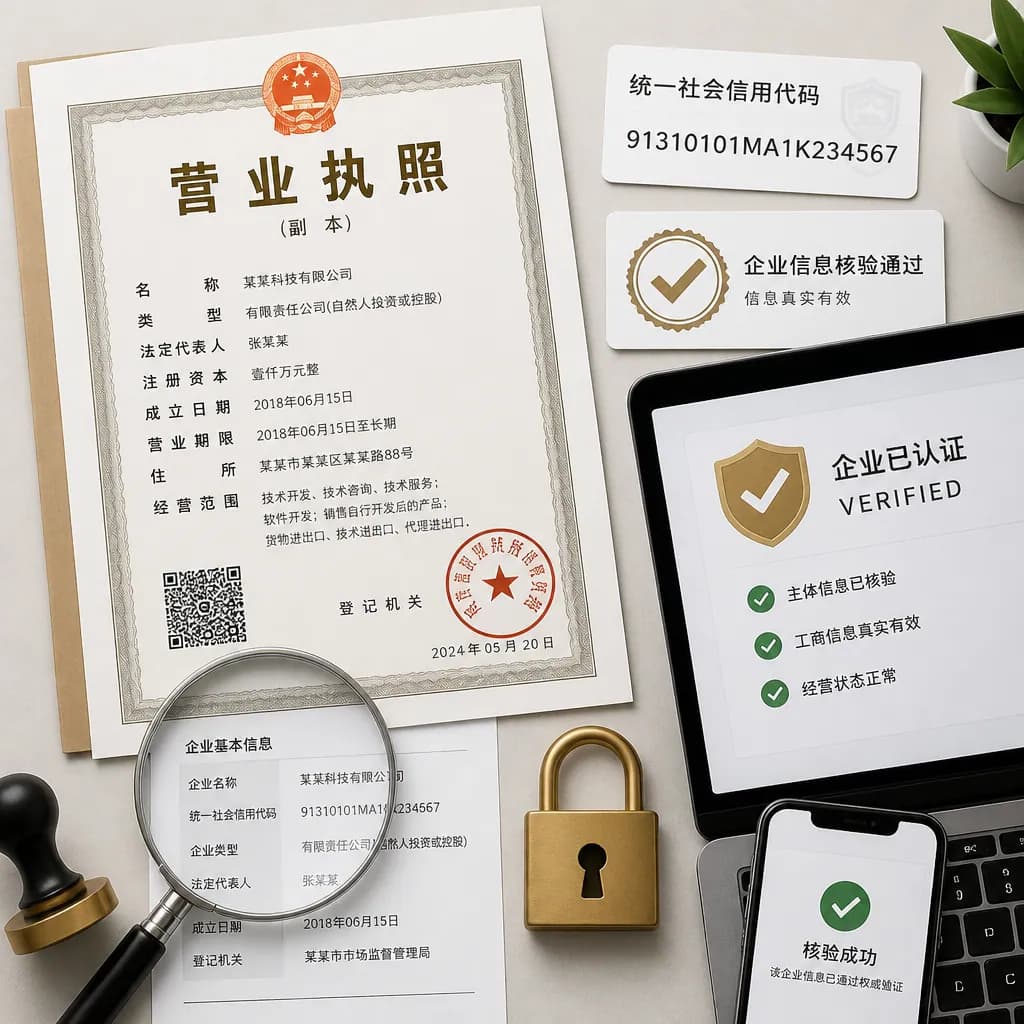
The single most reliable document in the Chinese business registration system is the business licence, known in Chinese as the 营业执照. Every legally registered company in China carries an 18-digit Unified Social Credit Code printed on this document. Request a clear photo or scan of it from any supplier you are considering.
Once you have the code, verify it directly on China’s National Enterprise Credit Information Publicity System, accessible at gsxt.gov.cn. This platform is operated by the State Administration for Market Regulation and is the authoritative registry for Chinese company information. Enter the Unified Social Credit Code and confirm that the legal name, registration status, and legal representative returned by the system match the licence character for character. Any discrepancy is a stop sign, not a yellow flag.
A common mistake buyers make at this stage is accepting a business licence PDF without cross checking it against the live government database. PDFs can be edited. The registry cannot. Also check the registered address shown on the licence. If the company claims to operate from a major export hub like Shanghai, Guangzhou, or Tianjin, but the registered address is a residential apartment in a small inland city, that warrants a direct explanation from the supplier before you proceed.
Pro tip: The English trading name on a supplier’s website has no legal standing in China. What matters legally is the Chinese name on the business licence. Confirm that both names are traceable to the same registered entity on gsxt.gov.cn before treating any English language contract as binding.
Check 2: Export Scope and Licensing
Registering a company in China and being authorized to export vehicles from China are two different things. The business licence scope section, listed in Chinese as 经营范围, must explicitly include vehicle sales or export. A company whose scope lists only “trading consultancy,” “import export agency,” or “general merchandise” may not be legally authorized to issue vehicle export documentation under its own name.
What the export licence covers
For new vehicle exports, the relevant authorization flows through the manufacturer’s official dealer or authorized distributor network. Ask the supplier to provide written confirmation of their relationship with the brands they claim to sell. A genuine authorized dealer can supply a manufacturer authorization letter. If the exporter is a trading company sourcing from dealers, they should be able to show the chain of documentation from the original manufacturer invoice through to the export customs declaration.
How to verify trade history
Any exporter with real operating history will be able to share redacted copies of past bills of lading, customs export declarations, or client references from buyers in your region. A bill of lading number can be verified directly on the website of the issuing shipping line, whether that is COSCO, Maersk, MSC, or another carrier. If the B/L number does not appear in the carrier’s tracking system, the document is fabricated. This is a fast check that costs nothing and takes under two minutes.
Pro tip: When reviewing a supplier’s trade history, ask for references from buyers in your specific region, whether that is West Africa, the Gulf, or Southeast Asia. Regional references are harder to fabricate than generic testimonials, and a legitimate exporter working your market regularly will have them.
Check 3: Corporate Bank Account Verification
This check stops a specific and common form of payment fraud before it happens. Before sending any funds, request a proforma invoice that includes the supplier’s company stamp and full bank details. Then verify that the bank account name matches the registered company name on the business licence exactly. Even one character of difference is a red flag serious enough to halt the transaction.
Be especially alert to mid transaction changes in banking details. A payment instruction that arrives by email, changes the account number from a previous communication, and stresses urgency should be treated as a compromised or fraudulent communication until you have confirmed it by voice call to a phone number you already had on file, not a number provided in the same suspicious message.
Avoid transferring funds through untraceable methods such as Western Union or MoneyGram. These channels offer no recourse if the transaction is fraudulent. Legitimate B2B vehicle exporters transact through corporate bank accounts, not personal accounts, and not informal payment processors.
A bank account name that does not match the business licence name exactly is not a minor administrative discrepancy. It is the most common technical setup used in vehicle export payment fraud, and it should end the conversation immediately.
Check 4: Vehicle Specific Documentation
Stock photos prove nothing. Any broker can download images from a manufacturer’s press kit and present them as their own inventory. What you need is vehicle specific evidence tied to the actual unit you are being asked to pay for.
What to request before payment
Request a live video walkaround of the specific vehicle, shot on the day you request it. Ask the supplier to include a reference item you specify in that same video, such as a handwritten note with the current date, or a specific object, to confirm the footage is current and not recycled. The video should show the VIN plate legibly, the dashboard odometer reading, and the exterior in a single continuous shot without cuts. A legitimate exporter with physical access to the vehicle does this within the same business day. A broker reselling stock they do not physically hold will send still photos instead.
Document set for new vehicles
For new vehicle exports from China, the standard document set includes the manufacturer’s original invoice, the Chinese customs export declaration (报关单), the certificate of origin, a vehicle inspection certificate, and the bill of lading issued by the shipping company. Before final payment, confirm that the VIN on all documents matches the VIN in the video. Inconsistencies across these documents are not clerical errors. They indicate fabricated paperwork.

Check 5: Independent Pre Shipment Inspection
A pre shipment inspection carried out by an agency you choose, not one the exporter appoints, is the strongest physical verification available to an overseas buyer. Internationally recognized agencies operating across China’s major vehicle export ports include SGS, Bureau Veritas (BV), and CCIC. These agencies can be hired directly by the buyer, and a legitimate exporter will coordinate access to the vehicle yard for the inspector without obstruction.
Any refusal to allow an independent pre shipment inspection is a disqualifier. A legitimate seller has nothing to hide from an independent audit. If an exporter resists, deflects, or conditions the inspection on additional fees they control, treat that as confirmation that something about the vehicle or the transaction does not match what they have told you.
The inspection scope for vehicle exports typically covers the exterior and interior condition, VIN verification, odometer reading, specification match against the order, and confirmation that the vehicle matches the documents. For electric vehicles and plug in hybrids, a battery state of health check is worth adding to the inspection brief, since battery condition is not visible and has a direct bearing on resale value and performance in your market.
Check 6: Digital Presence and Trade History
A supplier’s online presence is not proof of legitimacy on its own, but serious gaps in that presence are informative. Run a WHOIS lookup on the supplier’s domain. A domain registered within the last two to three months with only a one year registration period and no verifiable office address is a structurally higher risk than a supplier whose domain has been active for several years and whose website contains verifiable physical contact information.
A legitimate exporter’s website should carry a company legal name, a verifiable physical address, a landline or corporate phone number, and a company email address on a matched domain. A contact page that offers only a WhatsApp number and a contact form is not the standard of a serious B2B export operation. It does not disqualify a supplier entirely, but it shifts the burden of proof significantly toward them to demonstrate legitimacy through other channels.
Check whether the supplier maintains a presence on verified B2B platforms. A long standing, verified profile on an established trade platform adds a layer of accountability because these platforms require documentation to issue verified status. Also request two to three buyer references from your specific region and contact them directly. Ask how many orders they have completed with this supplier, whether specifications matched the original order, and how the exporter handled any post shipment issues. References who cannot speak to more than one transaction or who avoid direct answers on these points should reduce your confidence in the supplier.
Check 7: Payment Structure and Red Flags
Standard B2B payment terms for vehicle exports from China involve a deposit at order confirmation, typically around 30% of the vehicle value, followed by the balance before the vehicle is loaded for shipping. This structure protects both parties: the exporter has financial commitment from the buyer, and the buyer retains payment leverage until the vehicle has been inspected and is ready to ship. A demand for 100% payment upfront before any inspection or documentation verification is a major risk signal, regardless of how the exporter explains it.
Red flags that should stop a transaction
Watch for these specific warning signs across any communication with a potential supplier. An exporter who cannot provide a business licence within one business day has either not been asked before or is managing the delay strategically. Either way, it is not normal. An exporter who insists on payment to a personal bank account rather than a corporate account is operating outside standard B2B practice. An exporter who claims to have stock of a specific model but cannot produce a live vehicle video on request likely does not have physical access to the vehicle. And an exporter who pressures you to move quickly because “another buyer is interested” is using a sales tactic designed to accelerate your decision past the point of rational verification.
Milestone based payments are the appropriate structure for larger orders: a deposit to confirm the order, an update after pre shipment inspection with photographic evidence, and the balance released before loading. Keep all communication records regardless of the platform, since these records constitute evidence in any dispute resolution process.
Verification Method Comparison
Not all verification steps carry equal weight. The table below ranks the three most critical checks by reliability, the time required to complete them, and the type of risk each one mitigates.
| Verification Method | Reliability Level | Time to Complete | Risk Mitigated |
|---|---|---|---|
| Unified Social Credit Code check on gsxt.gov.cn | High (government registry, live data) | 5 to 10 minutes | Fake company identity, non existent registration |
| Independent pre shipment inspection (SGS, BV, CCIC) | High (physical, independent, documented) | 3 to 7 business days to arrange | Misrepresented vehicle condition, wrong specifications, VIN fraud |
| Live vehicle video with VIN verification | Medium High (harder to fake with specific prompts) | Same day if exporter has physical access | Stock photo fraud, non existent inventory, broker misrepresentation |
At Automotion Global, all three methods are applied as standard across every vehicle we supply. We provide buyers with verified business documentation, facilitate independent inspection by the agency of the buyer’s choice, and produce live vehicle evidence before final payment is requested. This process exists because it is the correct way to run an export operation, not because it is a marketing feature.
Frequently Asked Questions
What is the Unified Social Credit Code and where do I verify it?
The Unified Social Credit Code is an 18-digit identifier assigned to every registered company in China. It is printed on the company’s business licence. You can verify it for free on China’s National Enterprise Credit Information Publicity System at gsxt.gov.cn, which is operated by the State Administration for Market Regulation. Enter the code, solve the CAPTCHA, and confirm that the returned company name, status, and legal representative match the documents the supplier gave you. Any mismatch should halt the transaction immediately.
How do I verify a car exporter in China if I cannot visit in person?
Remote verification covers most of the critical risk if done thoroughly. Check the Unified Social Credit Code on gsxt.gov.cn. Verify the bank account name matches the business licence exactly. Request a live vehicle video shot on your instruction, not pre recorded footage. Hire an independent inspection agency such as SGS, Bureau Veritas, or CCIC to conduct a physical pre shipment inspection at the port or storage facility. These steps are sufficient to confirm basic legitimacy and vehicle condition without traveling to China.
What documents should a legitimate Chinese vehicle exporter provide?
For new vehicle exports, a legitimate exporter should provide the manufacturer’s original invoice, the Chinese customs export declaration, the certificate of origin, a vehicle inspection certificate, and the bill of lading from the shipping company. The VIN number must appear consistently across every document and must match the VIN plate shown in the vehicle video. If any document is missing or the VIN is inconsistent, request a clear explanation in writing before proceeding.
Is it safe to pay a Chinese vehicle exporter by bank transfer?
Corporate bank transfer is the standard and appropriate payment method for B2B vehicle imports from China. The critical verification step is confirming that the bank account name matches the registered company name on the business licence exactly. Never transfer funds to a personal account, and never follow a mid transaction change of bank details that arrives by email without voice confirmation to a pre existing contact number. Keep all payment records and correspondence as documentation in case of any dispute.
What are the most common scams in Chinese vehicle export?
The most common fraud patterns include: suppliers presenting fabricated business licence PDFs that do not match the live government registry; brokers using stock photos of vehicles they do not physically hold; requests for 100% payment upfront to a personal account before any documentation is verified; and mid transaction bank account substitution via email. A less obvious pattern involves exporters who facilitate one legitimate transaction to build trust and then use that credibility to execute a fraudulent second order. Verification steps must be repeated on every order, not just the first.
How long does a legitimate Chinese vehicle export take from order to delivery?
Transit times vary by destination port and shipping method. For most markets in the Middle East and Africa, sea freight from major Chinese export ports such as Shanghai, Tianjin, or Guangzhou typically takes between three and eight weeks, depending on the shipping route and whether the vehicle moves on a roll on roll off vessel or in a container. Pre shipment inspection, documentation preparation, and customs clearance at origin add time before the vessel departs. A realistic end to end timeline from order confirmation to arrival at your port is generally eight to fourteen weeks for standard orders.
Does Automotion Global provide verification documentation to buyers?
Yes. Automotion Global provides buyers with full business documentation, facilitates independent pre shipment inspection by the agency of the buyer’s choice, supplies vehicle specific evidence including live video and VIN-matched documents, and handles export customs documentation as part of the complete export solution. Buyers can apply every check in this article directly to Automotion Global before committing to an order.
If you have used any of these verification steps when sourcing vehicles from China, we would like to hear what worked, what surprised you, and where you ran into gaps so that other buyers in this community can learn from your experience.
References
- What to check when evaluating a trusted Chinese car export company: documentation, bank accounts, and live vehicle verification
- How to verify Chinese car suppliers and avoid scams: red flags, payment terms, and the Unified Social Credit Code
- How to check a Chinese company’s registration information using the official National Enterprise Credit Information Publicity System
- How independent pre shipment inspection works for Chinese vehicle exports: SGS, Bureau Veritas, and CCIC explained
- Step by step guide to verifying Chinese company documents and export paperwork when importing vehicles from China