

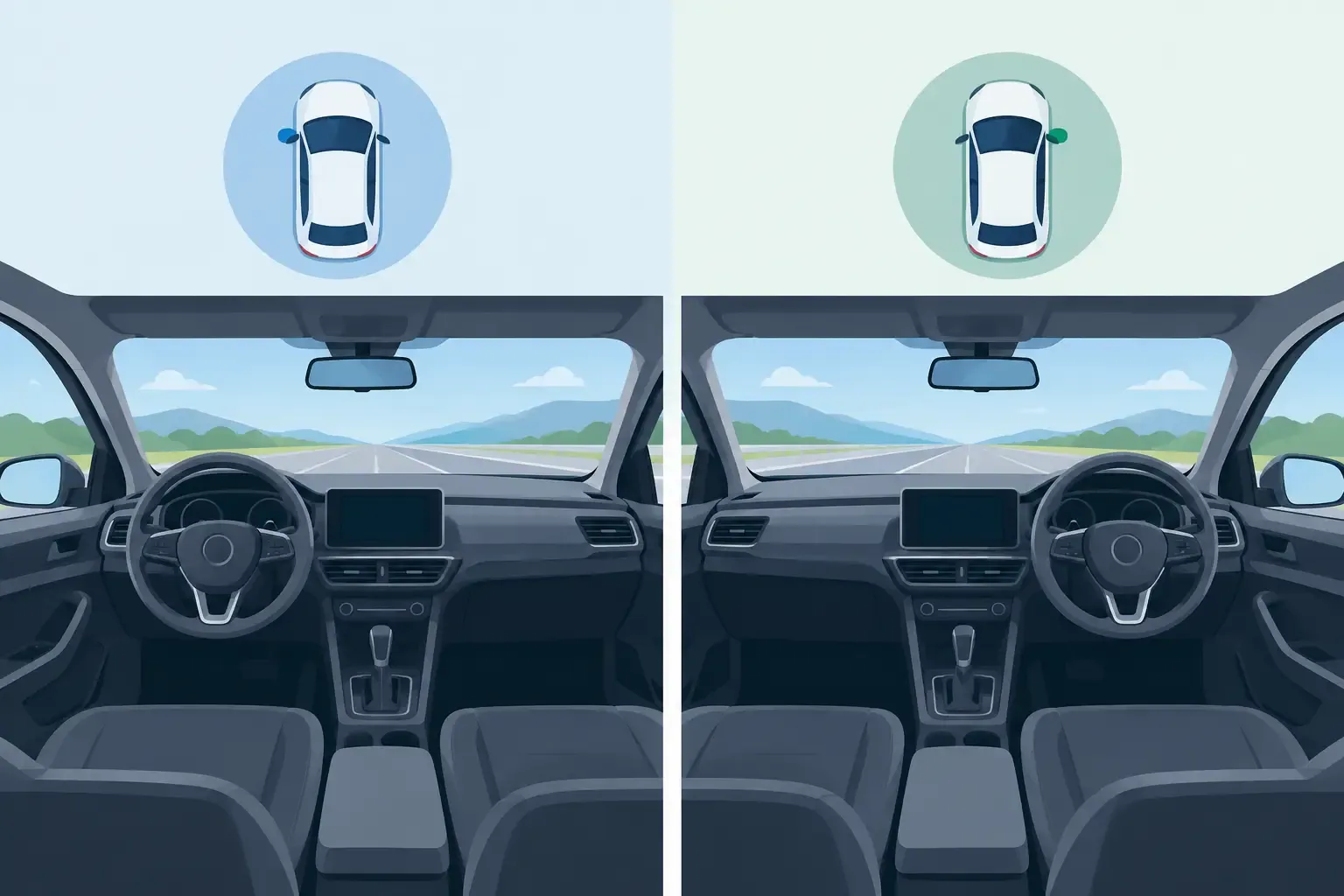
For an international buyer left versus right hand drive is not simply a steering wheel preference. It affects legal eligibility, driver safety, fleet deployment, parts planning, resale value, and the final cost of putting an imported vehicle into service. A vehicle can be highly specified, competitively priced, and ready for export, yet still be the wrong purchase if its driving position does not match the destination market or intended operation.
The practical decision starts with the road system where the vehicle will spend most of its life. From there, buyers should assess import rules, vehicle age, conversion feasibility, and the commercial purpose of the unit before confirming a purchase order.
Left Versus Right Hand Drive: The Core Difference
A left hand drive vehicle, commonly called LHD, places the steering wheel on the left side of the cabin. It is designed primarily for countries where traffic keeps to the right, including the United States, Canada, most of continental Europe, and much of Latin America and the Middle East.
A right hand drive vehicle, or RHD, places the steering wheel on the right side. It is standard in countries where traffic keeps to the left, including the United Kingdom, Japan, Australia, New Zealand, India, South Africa, and several markets in Africa, Asia, and the Caribbean.
The driving position is tied to more than steering wheel placement. Headlamp beam pattern, windshield wiper sweep, dashboard layout, mirror configuration, turn signal controls, and camera placement may all be designed for a specific traffic direction. For modern vehicles, especially EVs, PHEVs, and advanced commercial units, the electronic architecture can make a later conversion more complex than many buyers expect.
Match the Vehicle to Its Primary Operating Market
The simplest rule is also the most reliable: source LHD for right side traffic and RHD for left side traffic. This provides the most natural sight lines for passing, turning, toll lanes, parking facilities, and daily traffic flow.
For example, an RHD vehicle used regularly in the United States can be driven, but the operator sits farther from the center line on a typical road. Passing on two lane roads becomes less comfortable because forward visibility is reduced. Drive through lanes, parking gate kiosks, and some toll facilities can also be less convenient. Those factors may be manageable for a specialist collector vehicle or limited use unit, but they matter for a daily driver, delivery vehicle, executive transport fleet, or resale inventory.
The same principle applies in the opposite direction. An LHD SUV or commercial unit may be attractive because of its specification or stock availability, but it can create an operational disadvantage in an RHD market. Fleet managers should consider the experience of every driver, not just the procurement price.
There are exceptions. Security vehicles, mining units, airport vehicles, agricultural equipment, and certain site based commercial fleets may operate predominantly on private land. In those cases, road orientation may carry less weight than vehicle capability, protection level, payload, energy system, or service access. Even then, the route from port to site and any public road use must be considered.
Import Compliance Comes Before Vehicle Selection
Driving side and import eligibility are related but separate questions. A vehicle may be legal to operate in a destination country while still requiring specific import documentation, modifications, inspections, or exemptions.
For U.S. buyers, imported vehicles must meet applicable federal requirements or qualify under a recognized exemption. The well known 25-year rule can allow qualifying older vehicles to enter without needing to meet every current Federal Motor Vehicle Safety Standard. However, the vehicle’s age must be verified carefully, and importers must still address customs, Environmental Protection Agency requirements where applicable, title procedures, and state level registration rules.
A newer RHD vehicle is not automatically prohibited in the United States, but importation can be more difficult if it was not manufactured to U.S. standards. Do not assume that an attractive overseas market model can be registered simply because similar vehicles are sold domestically. Confirm the vehicle identification number, production date, compliance labels, emissions status, and the requirements of the intended state before shipping.
Other markets have their own rules. Some countries restrict the import of used RHD vehicles, some require LHD vehicles for registration, and some allow either configuration with conditions. Age limits, emissions rules, homologation procedures, duties, and inspection standards can change. Procurement teams should verify destination market requirements before placing a deposit, not after the vehicle reaches the port.
Why Conversion Is Usually a Last Resort
Converting a vehicle from right hand drive to left hand drive, or the reverse, may sound straightforward. On older, mechanical vehicles, a conversion can sometimes be completed to a usable standard with the right parts and experienced technicians. On a modern vehicle, the scope is often much larger.
A proper conversion may involve the steering rack, column, pedals, brake booster, dashboard, instrument cluster, HVAC housing, wiring harnesses, airbags, wiper motor and linkage, lighting components, and electronic control modules. The work can affect safety system calibration and may complicate insurance, warranty coverage, inspection approval, and future resale.
For EVs and hybrids, conversion should receive even more scrutiny. High voltage architecture, integrated driver assistance systems, digital displays, radar or camera functions, and software coding can increase cost and risk. A conversion that appears economical at purchase can become expensive once parts, labor, calibration, downtime, and compliance testing are included.
For most buyers, it is more efficient to source the correct factory built driving configuration from the beginning. Conversion is best reserved for specialty projects where the vehicle’s rarity, purpose, or value clearly justifies the work.
Consider Resale, Service, and Driver Familiarity
The right vehicle configuration protects value after delivery. In the United States, LHD vehicles generally have the broadest resale appeal because they align with local traffic patterns and buyer expectations. An RHD import may attract enthusiasts, collectors, postal route operators, or buyers seeking a particular Japanese market model, but its customer base is narrower.
For resellers, that does not make RHD inventory a poor choice. It means the stock strategy must be deliberate. A rare RHD performance model, vintage SUV, kei truck, or specialty utility vehicle can perform well when marketed to the correct audience and imported under the right compliance pathway. It should not be valued as a direct substitute for a mainstream LHD vehicle with broad consumer demand.
Service support also deserves attention. Routine maintenance may be available through capable workshops, but configuration specific components can take longer to source. Body panels, headlights, dashboards, steering assemblies, and certain interior trims may differ between LHD and RHD versions. Before purchase, commercial buyers should assess access to parts, diagnostic capability, and trained technicians in their operating region.
Driver familiarity matters most in multi driver fleets. A driver who is accustomed to LHD may adapt to RHD, but adaptation takes time and should not be treated as a minor issue in high mileage or safety sensitive operations. Clear fleet policies, route planning, and driver orientation can reduce risk where a nonstandard configuration is necessary.
Evaluate the Full Landed Cost, Not Just FOB Price
An export quotation can be competitive while the final delivered cost is not. Buyers should evaluate the complete commercial picture: vehicle price, inland transport, port handling, ocean or air freight, insurance duties, taxescustoms clearance, inspections, registration, modifications, and expected maintenance.
The driving configuration may influence several of those costs. An uncommon configuration can affect insurance appetite, conversion requirements, lead times for replacement parts, and resale velocity. For fleet operators, even small productivity losses from unsuitable ergonomics or difficult route access can accumulate over years of service.
This is why pre shipment inspection is valuable. It confirms not only cosmetic condition and mechanical operation, but also the exact steering configuration, odometer reading, vehicle identification details, specification, and export documentation. Buyers should request clarity on what is included in the sale and what remains their responsibility in the destination market.
A Practical Sourcing Decision
Start with the country of registration and the roads the vehicle will use most often. Then confirm local import eligibilityregistration requirements, and the commercial purpose of the vehicle. Only after those points are clear should price, trim level, powertrain, and optional equipment determine the final choice.
For buyers sourcing internationally, Automotion Global can help align available export ready stock with the required vehicle configuration and shipment destination. The strongest purchase is not merely the vehicle that is available now. It is the vehicle that arrives documented, compliant, operationally suitable, and ready to deliver value from its first day on the road.