
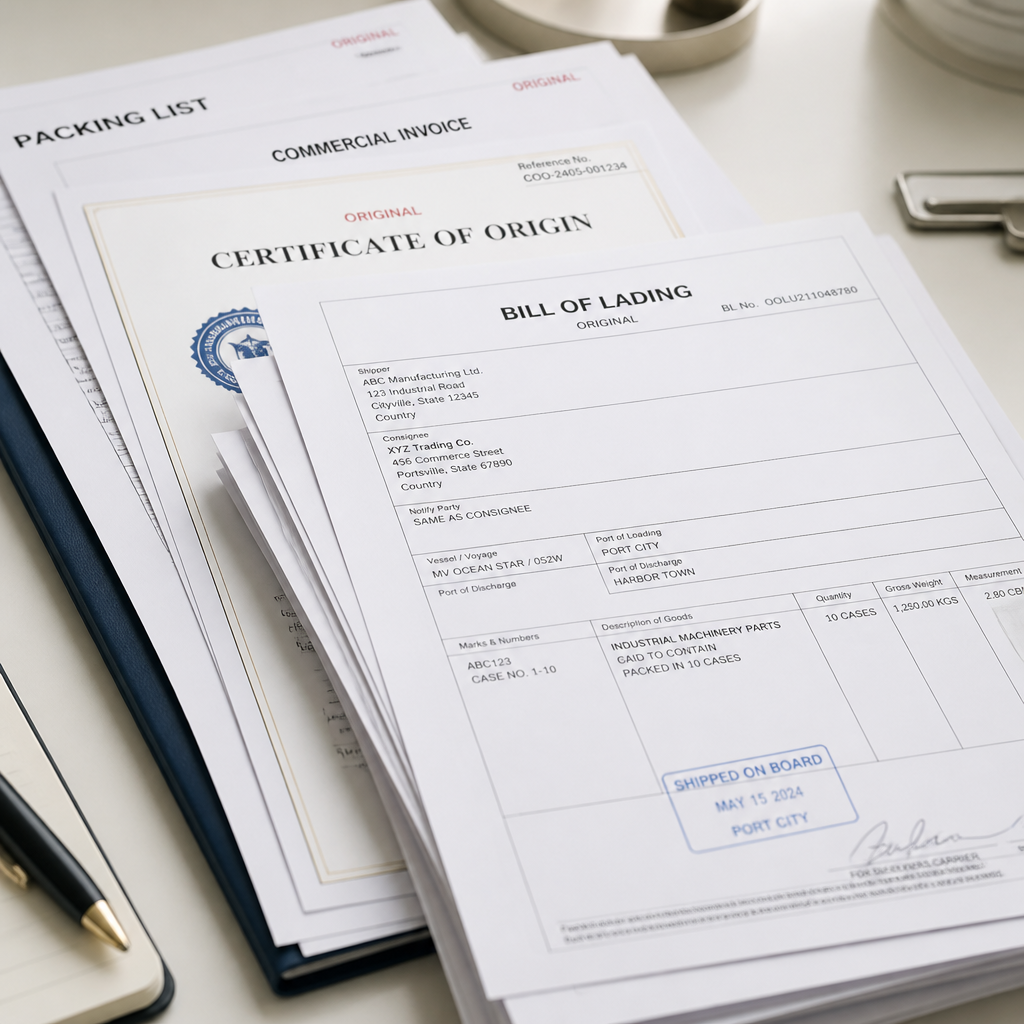
A single missing document can hold an entire shipment at port, delay registration for months, and cost an importer far more than the vehicle itself. Yet many buyers sourcing through Chinese vehicle suppliers still treat paperwork as an afterthought. If you are importing passenger cars, EVs, SUVs, or commercial vehicles from China, understanding vehicle export documentation China requirements before you place an order is not optional. It is the foundation that determines whether your shipment moves smoothly or turns into an expensive lesson. This guide lays out every document you need, where common mistakes happen, and how a proper export partner makes the difference.
Table of Contents
- Quick Takeaways
- The Core Export Documents Every Importer Must Have
- Car Import Paperwork: What Your Destination Country Adds
- The Export Certificate for Chinese Vehicles Explained
- Additional Documentation for EVs and PHEVs
- Document Verification and the Most Common Mistakes
- Comparing Export Documentation Approaches
- Frequently Asked Questions
- References
Quick Takeaways
| Key Insight | Explanation |
|---|---|
| The commercial invoice must match the bill of lading exactly | Any discrepancy between the vehicle description, VIN, or value on these two documents triggers customs holds at most destination ports. |
| The Certificate of Origin is not automatic | It must be applied for through CCPIT (China Council for the Promotion of International Trade) and is essential for preferential tariff rates under applicable free trade agreements. |
| An export license is a legal requirement for the Chinese exporter | Your supplier must hold a valid export license from the Chinese Ministry of Commerce. Buying from a supplier without this qualification means your shipment may be seized before it leaves China. |
| Destination-country compliance certificates are separate from Chinese export documents | Type approval, homologation, or roadworthiness certificates are required by the importing country and must be arranged independently of Chinese customs clearance. |
| All documents should be bilingual (Chinese and English) | Most destination-country customs authorities and banks handling letters of credit require English-language versions of all shipping documents, legally stamped. |
| The VIN appears on multiple documents and must be consistent throughout | A single transposed digit in the VIN across the invoice, B/L, and customs declaration will cause a document mismatch that delays or blocks vehicle registration in the destination country. |
| Pre-shipment inspection reports add a layer of protection | An independent third-party inspection certificate confirms the vehicle’s condition, specification, and compliance before loading, protecting the importer and satisfying some destination customs requirements. |
The Core Export Documents Every Importer Must Have
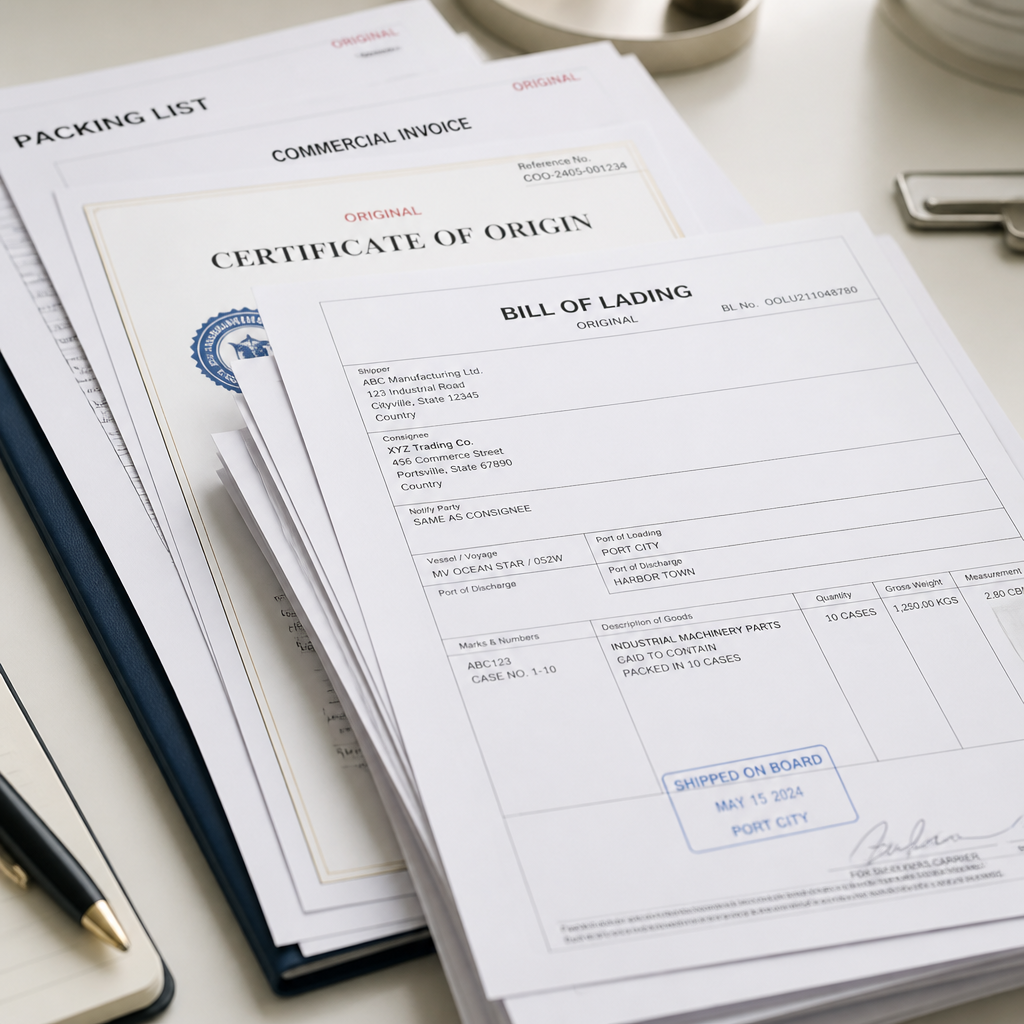
There is a standard set of documents that applies to virtually every vehicle exported from China, regardless of destination. Think of these as the non-negotiable baseline. Missing any one of them means your cargo either does not leave China, does not clear destination customs, or cannot be registered for road use.
Commercial Invoice
The commercial invoice is the foundational transaction document. It must include the full names and addresses of the buyer and seller, a precise vehicle description including make, model, year, VIN, engine number, and displacement, the agreed price, currency, and terms of sale (usually Incoterms such as FOB, CIF, or EXW). The value declared on the commercial invoice directly affects import duty calculations, so undervaluing is both a legal risk and a practical one if the destination customs authority disputes it.
A proforma invoice is typically issued earlier in the process to confirm the transaction terms before the final commercial invoice is produced. Both documents serve different stages of the import process and both should be retained.
Packing List
For vehicles, the packing list records the unit dimensions, gross and net weights, and container or RoRo stowage details. It helps customs officials at the destination port verify the shipment contents without physically inspecting every container. In practice, a poorly prepared packing list with incorrect weight or container numbers is one of the most common causes of customs holds.
Bill of Lading
The Bill of Lading (B/L) is the legal contract between the exporter and the shipping carrier. It serves simultaneously as a receipt for the cargo, a document of title, and the contract of carriage. For vehicle imports, you will either receive an original B/L (required to take possession of the vehicle) or a telex release (an electronic authorization allowing the consignee to collect without an original paper document). Know before shipment which form your trade finance arrangement requires, because changing this mid-transit is costly and slow.
Export Customs Declaration Form
The Chinese exporter is required to submit a customs declaration form to Chinese Customs (the General Administration of Customs of China) before the vehicle can exit the country. This form records the exporter, consignee, vehicle description, HS code, declared value, and destination. The HS code for passenger vehicles typically falls under Chapter 87 of the Harmonized System. An incorrect HS code triggers a re-assessment by both Chinese and destination-country customs, adding delays and potential penalty duties.
Pro tip: Request a copy of the signed and stamped Chinese customs declaration form from your exporter before the vessel departs. This document is your proof that the goods were legally exported and is frequently requested by destination customs authorities, banks, and vehicle registration offices.
Certificate of Origin
The Certificate of Origin (COO) is issued by the CCPIT (China Council for the Promotion of International Trade) or by China’s local Chambers of Commerce. It officially certifies that the vehicle was manufactured in China. This document is critical for importers in countries that have free trade agreements with China, as it unlocks preferential import duty rates. For markets in the Middle East and Africa, the COO is routinely required for customs clearance regardless of any FTA status.
Car Import Paperwork: What Your Destination Country Adds
The documents listed above are the Chinese export side of the equation. Your destination country adds its own layer of car import paperwork, and this is where importers frequently get caught out. The combination of both sets determines whether a vehicle gets released, registered, and legally driven.
Import Declaration and Customs Entry
Every vehicle entering a foreign country must be formally declared to that country’s customs authority. The import declaration references the Chinese export documents (particularly the commercial invoice and B/L) and triggers the assessment of import duties, VAT, and any applicable levies. The declared customs value must be consistent with the commercial invoice; discrepancies are one of the most scrutinized areas in vehicle imports.
Import License or Permit
In several markets, particularly across the Middle East and Africa, certain vehicle categories or specifications require a formal import license or permit issued by the destination country’s trade or transport authority before the shipment even departs China. Failing to secure this before loading results in vehicles being held at the destination port, incurring demurrage charges that accumulate daily.
Type Approval or Homologation Certificate
This is the document most frequently underestimated by first-time importers of Chinese vehicles. Type approval confirms that the specific vehicle model meets the safety, emissions, and technical standards of the destination country. Without it, the vehicle cannot legally be registered for road use. In the European Union, vehicles require formal type approval under EU frameworks. In Gulf Cooperation Council (GCC) markets, vehicles must comply with GSO (Gulf Standardization Organization) standards. In other markets, equivalent national certifications apply.
Type approval must be arranged before or alongside the order, not after the vehicle arrives. Some Chinese manufacturers produce region-specific variants of their vehicles that already carry the relevant approvals for target markets. Always confirm this with your supplier before committing to a specification.
Pro tip: When sourcing Chinese vehicles for Middle East or African markets, always ask the supplier for the specific build specification and any existing type approval documentation for those regions. A vehicle built for the Chinese domestic market and a vehicle built for export to the GCC are not the same unit, and the documentation differs accordingly.
Pre-Shipment Inspection Certificate
Some destination countries, particularly in Africa, mandate a pre-shipment inspection by an approved third-party agency before the vehicle leaves China. Even where it is not legally mandated, a pre-shipment inspection report from an independent inspector provides the importer with documented evidence of the vehicle’s specification and condition at the point of loading. This report protects the buyer in any subsequent dispute with the supplier and can satisfy additional customs requirements at destination.

The Export Certificate for Chinese Vehicles Explained
The term “export certificate” for Chinese vehicles actually refers to more than one document, and the confusion around this term causes real problems. Here is a precise breakdown of what the term covers.
The Manufacturer’s Certificate of Conformity
The Certificate of Conformity (COC) is issued by the vehicle manufacturer and certifies that the specific vehicle unit conforms to the approved type. It lists the vehicle’s technical specifications, emissions classification, and the approval numbers relevant to specific regulatory standards. For importers, this document is foundational to obtaining type approval or roadworthiness certification in the destination country. Without a COC from the Chinese manufacturer, obtaining destination-country registration becomes significantly more complex.
The Exporter’s Export License
China’s Ministry of Commerce requires vehicle exporters to hold a specific export license covering automotive products. This is a business-level qualification held by the exporting company, not a document issued per shipment. As an importer, you should verify that your Chinese supplier holds this license before signing a purchase contract. A supplier without this qualification cannot legally export vehicles from China, and any shipment they attempt to make is at risk of being stopped by Chinese Customs.
The Vehicle Registration Certificate (for Domestic-Registered Vehicles)
For vehicles that were briefly registered in China before export (a situation that occurs in certain near-new or pre-delivery scenarios), the Chinese motor vehicle registration certificate must accompany the shipment and must be annotated to indicate the vehicle is being transferred for export. This documentation chain is mandatory and verifiable by destination customs.
Getting the export certificate right from the Chinese side is only half the job. The real documentation work begins when you match those Chinese documents against what your destination country actually requires for registration. Most clearance failures happen in that gap.
Additional Documentation for EVs and PHEVs
Electric vehicles and plug-in hybrid vehicles sourced from China carry additional documentation requirements beyond those applied to conventional vehicles. This reflects the fact that EVs involve high-voltage battery systems, new powertrain technologies, and specific regulatory frameworks that most countries are still developing and updating.
Battery Safety and UN 38.3 Test Report
Lithium-ion battery packs in EVs are classified as dangerous goods for shipping purposes. Carriers and destination customs authorities typically require a UN 38.3 test report, which certifies that the battery pack has passed the required series of safety tests covering temperature, vibration, shock, external short circuit, impact, overcharge, and forced discharge. This report must be provided by the battery manufacturer and should name the specific battery model installed in the vehicle being shipped.
EV-Specific Type Approval Documentation
Type approval for electric vehicles in most destination markets includes additional technical requirements beyond those for conventional vehicles, covering aspects such as maximum operating voltage, electrical safety, electromagnetic compatibility (EMC), and charging system standards. Destination countries in the EU have specific approval requirements under their regulatory frameworks for EVs. Importers sourcing Chinese EVs for resale in any regulated market should confirm the available type approval documentation with the manufacturer before purchase.
Charging Standards Compliance Documentation
Different markets use different charging connector standards. Chinese EVs are often produced with GB/T connectors for the domestic market. Vehicles exported to other markets may need to be fitted with CCS2, CHAdeMO, or other region-specific connectors. Documentation confirming the charging standard compatibility and any modifications made is required by some destination markets as part of the vehicle registration process.
Document Verification and the Most Common Mistakes
In practice, the majority of vehicle import problems trace back to a small number of recurring document errors. Knowing these in advance puts you ahead of most importers.
VIN Consistency Across All Documents
The Vehicle Identification Number must be identical across every document in the set: commercial invoice, bill of lading, customs declaration, certificate of origin, and certificate of conformity. A single transposed digit, whether it is a typographical error by the exporter or a data-entry mistake by the freight forwarder, will create a document mismatch. Destination customs authorities and vehicle registration offices check VINs against multiple documents as standard procedure. Correcting a VIN error after a vessel has departed often requires amended documents that take days to process and can hold the vehicle at the destination port.
Declared Value Below Market Value
Some importers pressure suppliers to understate the commercial invoice value to reduce import duties at destination. This is customs fraud and carries serious legal consequences in most jurisdictions, including seizure of the vehicle, financial penalties, and damage to the importer’s trade license. Destination customs authorities in the Middle East and Africa have become increasingly sophisticated at flagging values that fall below reference prices for known vehicle models.
Using Uncertified Suppliers
Working with a Chinese supplier that does not hold proper export qualifications creates a document set that looks complete on the surface but fails at the exit point from China or at destination customs. The Chinese Customs export declaration form and the export license in particular cannot be falsified without criminal liability, and destination authorities cross-reference these documents routinely.
Missing or Late Certificate of Origin
The CCPIT Certificate of Origin takes time to obtain and must be applied for by the exporter. A common mistake is for the importer to assume it will be included automatically. It must be explicitly requested and confirmed as part of the shipment documentation checklist. If the COO is not on board with the shipment, the importer typically loses access to preferential tariff rates and must pay full duty rates, which on passenger vehicles can be substantial.
Comparing Export Documentation Approaches
Not all importers manage their documentation the same way. The approach you choose affects your exposure to risk, your cost of clearance, and the speed of vehicle registration at destination.
| Approach | How It Works | Risk and Suitability |
|---|---|---|
| Full-service export partner (such as Automotion Global) | The export partner manages sourcing, document preparation, pre-shipment inspection, customs declaration, shipping, and provides a complete verified document set to the importer. | Lowest documentation risk. Suitable for dealers, distributors, and fleet operators who need volume shipments and cannot dedicate internal staff to document management. Partner accountability creates a single point of responsibility. |
| Direct factory purchase with freight forwarder | Importer buys direct from the Chinese manufacturer and appoints a local freight forwarder to handle export customs and shipping documentation. | Medium risk. Depends heavily on the competence of the freight forwarder and the factory’s export compliance. Works well if the importer has existing experience with Chinese customs procedures and a reliable forwarder relationship. |
| Trading company with no export license verification | Importer buys through a Chinese trading intermediary without verifying that the intermediary holds valid export qualifications or checking the document chain. | High risk. Trading companies without proper export licenses produce documentation that fails at Chinese customs exit, or produces a paper trail that does not withstand scrutiny at destination. Most documented vehicle import problems begin here. |
Frequently Asked Questions
What is the minimum set of documents required to import a vehicle from China?
The minimum required set includes a commercial invoice, a packing list, a bill of lading, a Chinese customs export declaration, a certificate of origin, and the vehicle’s certificate of conformity from the manufacturer. Depending on your destination country, you may also need an import license, a pre-shipment inspection certificate, and destination-country type approval documentation. No single document in this set can be treated as optional. A full-service export partner coordinates all of these as a matter of course.
Who issues the Certificate of Origin for Chinese vehicles?
The Certificate of Origin for Chinese export vehicles is typically issued by CCPIT (China Council for the Promotion of International Trade) or by the local branch of the China Chamber of International Commerce. The Chinese exporting company applies for it on a per-shipment basis, and it must be explicitly requested as part of the documentation package. It is not issued automatically with every shipment. Importers in countries with free trade agreements with China should ensure this document is always included, as it is the qualifying document for preferential tariff rates.
How do I verify that a Chinese vehicle supplier has a valid export license?
You can request a copy of the supplier’s export license directly and cross-reference it with China’s Ministry of Commerce business registration records. A reputable export partner will provide this documentation without hesitation. Be cautious of suppliers who are vague about their export qualifications, offer prices that seem significantly below market, or cannot provide a complete sample document set from a previous shipment. These are consistent indicators of a supplier without proper export qualifications. Automotion Global works exclusively with suppliers who hold verified export qualifications and maintains full documentation transparency for every shipment.
Do I need special documents to import Chinese electric vehicles?
Yes. In addition to the standard export document set, Chinese EVs require a UN 38.3 battery safety test report for the vehicle’s specific battery pack, EV-specific type approval documentation for the destination market, and in some cases, documentation confirming charging system compatibility with the destination country’s standard. The type approval requirements for EVs are more detailed than for conventional vehicles in most regulated markets, and some destination countries are still developing their specific EV import frameworks. Always confirm the current requirements with your destination customs authority or a specialist import agent before ordering.
What happens if the VIN on the bill of lading does not match the commercial invoice?
A VIN mismatch across shipping documents is treated as a document discrepancy by customs authorities. In most cases, the shipment is held pending amended documents, which must be issued by the original document holder, stamped, and in some cases countersigned. The process typically takes several business days at minimum and can take significantly longer if the vessel has already departed China, as the amendment must be coordinated between the Chinese exporter, the freight forwarder, and the shipping line simultaneously. This is one of the most preventable delays in vehicle importing and is avoided entirely by a thorough document check before vessel departure.
Can I import Chinese vehicles without a freight forwarder or export partner?
Technically, an importer can manage the process independently, but the complexity of coordinating Chinese export customs, international shipping documentation, destination customs clearance, and vehicle compliance certification makes this impractical for anyone who is not doing this full time. For vehicle dealers, distributors, and fleet operators focused on their core business, working with a specialist export partner who manages the complete documentation chain eliminates a major source of operational risk and frees internal resources for sales and customer service rather than paperwork management.
Have you run into documentation issues when importing vehicles from China? Share your experience or questions in the comments below and our team will respond directly.
References
- Full guide to exporting vehicles from China to Europe: customs clearance, documentation, and regulatory compliance requirements
- Essential documents required for export shipments involving China, with explanations of each document’s role in customs clearance
- How to buy and export cars from China: export license requirements, customs documents, and buyer guidance
- Complete guide to vehicle export documentation from China including certificate of origin, bill of lading, and destination-country certification requirements
- China vehicle export regulations and documentation requirements including export license rules and compliance documentation standards