
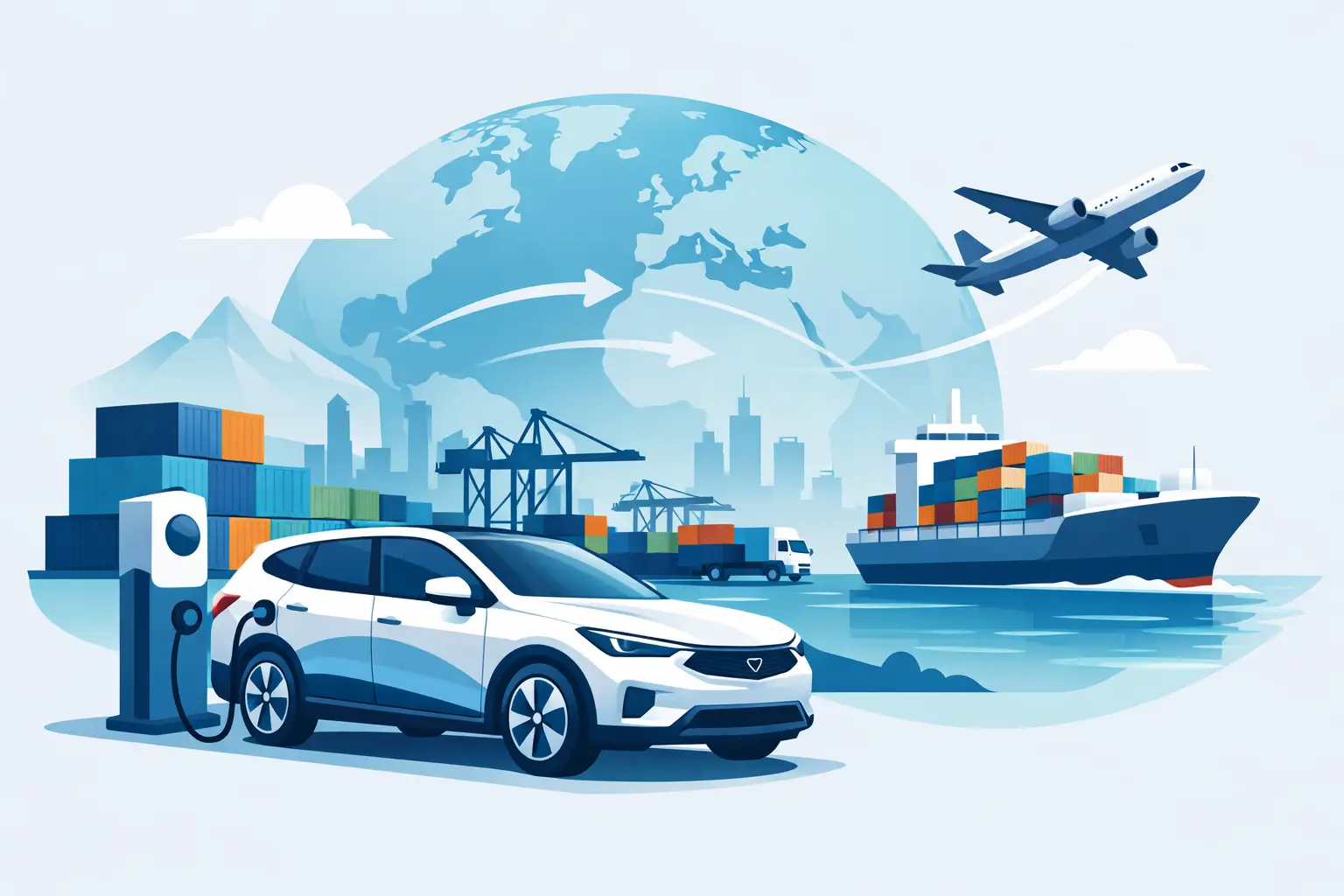
Extended range electric vehicle export is no longer a niche opportunity reserved for early EV adopters. For importers, fleet operators, and international resellers, EREVs have become a practical solution that combines electric driving with greater operational flexibility.
That matters in markets where charging infrastructure is still developing, long-distance driving is common, or buyers want electrified mobility without fully depending on public charging networks.
An extended-range electric vehicle, commonly called an EREV, operates primarily through electric drive while using a small internal combustion engine as a generator to recharge the battery when needed. That distinction is important because an EREV is not the same as a traditional hybrid and not the same as a full battery electric vehicle.
In international trade, those technical differences directly affect buyer demand, customs classification, service planning, and long-term usability.
Why extended range electric vehicle export is growing rapidly
The demand is straightforward. Many buyers want the efficiency, lower operating costs, and modern positioning of electrified vehicles without accepting the charging limitations that still exist in many regions.
An EREV creates a middle ground.
For personal buyers, this means less range anxiety and more flexibility for mixed city and long-distance driving. For fleets, it can reduce fuel consumption while maintaining operational reliability in areas where charging density remains inconsistent. For resellers, it opens access to customers interested in EV technology but not yet ready for a fully electric platform.
This is where export-ready sourcing becomes critical. The vehicle itself is only part of the transaction. International buyers also need accurate specifications, verified condition, proper documentation, and reliable shipping coordination.
A vehicle that appears attractive online can quickly become a poor purchase if battery condition, charging compatibility, software language, or compliance details are not confirmed before shipment.
What makes an EREV different in export transactions
In practical terms, EREVs sit between full EVs and plug-in hybrids, but export buyers should avoid oversimplifying the technology.
In most EREV systems, the combustion engine supports battery charging rather than directly powering the wheels in the same way many conventional hybrids operate. That architecture affects maintenance expectations, fuel economy positioning, and how the vehicle is marketed to end users.
From an export perspective, the main advantage is operational flexibility. In countries with unreliable charging access, an EREV can often be easier to commercialize than a pure EV.
At the same time, buyers should not assume every country treats EREVs the same way. Tax structures, registration policies, import classification, and incentives can vary significantly depending on battery size, engine displacement, or drivetrain design.
That is why extended range electric vehicle export decisions should never be based on FOB pricing alone. The real question is whether the exact specification matches the destination market technically, commercially, and legally.
The key checks before buying an EREV for export
The first step is confirming market suitability. Not every EREV that performs well in one country will succeed equally in another. Climate, fuel quality, charging infrastructure, road conditions, and consumer expectations all influence the ownership experience.
A city-focused EREV may work extremely well in urban environments but become less attractive in regions dominated by heavy highway usage or rough-road conditions.
The second step is documentation verification. Buyers should confirm the VIN, manufacturing year, trim level, battery specification, odometer reading, and inspection status before proceeding with payment.
If the purchase involves multiple units for fleet or resale purposes, consistency across inventory becomes even more important. Mixed trim levels or inconsistent specifications can complicate maintenance, pricing, and aftersales planning later.
The third step is charging compatibility. Even though EREVs can continue operating when battery charge decreases, charging standards still matter. Buyers should verify charging input types, plug compatibility, and adapter requirements for the destination market.
The fourth step is aftersales readiness. EREVs reduce dependence on charging infrastructure, but they still require support for high-voltage systems, software controls, and battery-related servicing. A private buyer importing one vehicle may tolerate more complexity than a fleet operator importing twenty units.
Compliance and customs are where strong deals fail
Many international buyers focus heavily on sourcing and not enough on import procedures. That is one of the biggest mistakes in extended range electric vehicle export.
Import approval may depend on emissions classification, homologation standards, battery transport procedures, or local registration eligibility.
The challenge is that electrified vehicles are not always handled consistently across markets. One country may encourage EREVs as a transition technology, while another may prioritize full EVs or require additional technical documentation before approval.
There may also be port-specific procedures related to lithium battery declarations and carrier handling requirements.
This is why pre-shipment verification matters so much. It is far better to solve technical and documentation issues before cargo is booked rather than after the vehicle arrives at destination port.
A professional export partner should be able to confirm commercial invoices, ownership records where applicable, inspection reports, battery-related declarations, and shipping methods without leaving operational gaps for the buyer to solve independently.
Shipping considerations for EREV exports
Shipping an EREV is not identical to shipping a conventional gasoline vehicle. Because the vehicle includes a battery system and electrified drivetrain, transport planning must account for carrier policies, port handling rules, and destination customs procedures.
The shipping method usually comes down to container transport or roll-on/roll-off depending on the route, vehicle type, protection requirements, and destination infrastructure.
Container shipping often provides greater protection and easier consolidation with accessories or spare parts. RoRo shipping can reduce costs on established trade lanes but depends heavily on route availability and port infrastructure.
Battery state of charge, physical inspection, and shipping condition should also be managed properly before loading.
For business buyers, lead time is just as important as freight cost. A lower freight quote does not always create better value if it introduces additional handling complexity, weak transit visibility, or higher transshipment risk.
Who benefits most from EREV export
EREVs are especially attractive in developing EV ecosystems where charging infrastructure continues to expand but is not yet fully mature.
This includes importers supplying private consumers, companies building mixed-energy fleets, and resellers looking for inventory that bridges the gap between traditional combustion vehicles and fully electric models.
They are particularly effective in markets where fuel remains widely available while charging access outside major cities remains inconsistent.
That said, the ideal solution still depends on the buyer’s operational model. Fleets with predictable routes and charging access may still prefer full battery EVs for long-term efficiency. Buyers focused on resale in charging-sensitive markets may find EREVs easier to position commercially.
The right decision depends on infrastructure, customer expectations, aftersales capability, and intended use.
Choosing the right export partner
In extended range electric vehicle export, sourcing inventory is only one part of the transaction.
Buyers need confidence that the vehicle is available, correctly represented, inspected before shipment, and supported by a team that understands international documentation, shipping coordination, and delivery timelines.
That is where operational discipline matters more than marketing language.
A serious export partner should be able to confirm stock status quickly, provide export-ready specifications, coordinate freight, and maintain clear communication throughout the process.
For buyers handling high-value international transactions, responsiveness and accuracy are not optional. They are the baseline.
Automotion Global operates in that space by focusing on export-ready inventory, supplier access, pre-shipment verification, and worldwide delivery coordination for buyers requiring dependable cross-border automotive fulfillment.
EREV demand will likely continue expanding as electrified mobility develops at different speeds across global markets.
The smartest buyers are not simply chasing trends. They are verifying the vehicle, verifying the route, and making sure the export process is as ready as the inventory itself.